

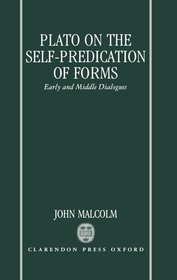
Plato on the Self-Predication of Forms
Early and Middle Dialogues
- Publisher's listprice GBP 175.00
-
79 012 Ft (75 250 Ft + 5% VAT)
The price is estimated because at the time of ordering we do not know what conversion rates will apply to HUF / product currency when the book arrives. In case HUF is weaker, the price increases slightly, in case HUF is stronger, the price goes lower slightly.
- Discount 10% (cc. 7 901 Ft off)
- Discounted price 71 111 Ft (67 725 Ft + 5% VAT)
Subcribe now and take benefit of a favourable price.
Subscribe
79 012 Ft

Availability
printed on demand
Why don't you give exact delivery time?
Delivery time is estimated on our previous experiences. We give estimations only, because we order from outside Hungary, and the delivery time mainly depends on how quickly the publisher supplies the book. Faster or slower deliveries both happen, but we do our best to supply as quickly as possible.
Product details:
- Publisher Clarendon Press
- Date of Publication 27 June 1991
- ISBN 9780198239062
- Binding Hardback
- No. of pages238 pages
- Size 224x144x19 mm
- Weight 442 g
- Language English 0
Categories
Long description:
Much of the recent literature published on Plato's metaphysics has involved the Third Man Argument found in his dialogue Parmenides. This argument depends upon construing Forms both as universals and as paradigm examples, and thus as being subject to self-predication.
Professor Malcolm first presents a new and radical interpretation of Plato's earlier dialogues. He argues that the few cases of self-predication contained therein are acceptable simply as statements concerning universals (for example, `beauty is beautiful'), and that therefore Plato is not vulnerable in these cases to the Third Man Argument.
In considering the middle dialogues, Professor Malcolm takes a conservative stance, rejecting influential current doctrines which portray the Forms as being not self-predicative. He shows that the middle dialogues do indeed take Forms to be both universals and paradigms, and thus to exemplify themselves. The author goes on to consider why Plato should have been unsuccessful in avoiding self-predication. He shows that Plato's concern to explain how the truths of mathematics can indeed be true played an important role in his postulation of the Form as an Ideal Individual. The author concludes with the claim that reflection on the ambiguity of such notions as the `Standard Yard' may help us to appreciate why Plato failed to distinguish Forms as universals from Forms as paradigm cases.
`He [Malcolm] gives a good account of competing interpretations, and a very defensible view of why it was that Plato was led to write as he did.'
Heythrop Journal

