

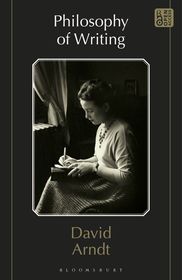
Philosophy of Writing
- Publisher's listprice GBP 16.99
-
7 670 Ft (7 305 Ft + 5% VAT)
The price is estimated because at the time of ordering we do not know what conversion rates will apply to HUF / product currency when the book arrives. In case HUF is weaker, the price increases slightly, in case HUF is stronger, the price goes lower slightly.
- Discount 18% (cc. 1 381 Ft off)
- Discounted price 6 290 Ft (5 990 Ft + 5% VAT)
- Discount is valid until: 5 August 2026
Subcribe now and take benefit of a favourable price.
Subscribe
6 290 Ft

Availability
Estimated delivery time: In stock at the publisher, but not at Prospero's office. Delivery time approx. 3-5 weeks.
Not in stock at Prospero.
Why don't you give exact delivery time?
Delivery time is estimated on our previous experiences. We give estimations only, because we order from outside Hungary, and the delivery time mainly depends on how quickly the publisher supplies the book. Faster or slower deliveries both happen, but we do our best to supply as quickly as possible.
Product details:
- Publisher Bloomsbury Publishing (UK)
- Date of Publication 8 January 2026
- ISBN 9781350473898
- Binding Paperback
- No. of pages224 pages
- Size 196x128x20 mm
- Weight 180 g
- Language English 652
Categories
Long description:
Why write? Why care about writing well?
Most philosophers have seen writing as inferior to speech as a way to move toward truth. Just a few thinkers-including Epictetus, Nietzsche, Arendt, Foucault, Morrison, and Anzald---a-have said that writing itself can be part of the search for understanding. But how can this be true?
In this pathbreaking work, David Arndt argues that our views of writing have been distorted by common concepts of truth, goodness, and beauty, and that we have to critically rethink these concepts in order to better understand in what senses writing can be beautiful, good, and true. He distinguishes several kinds of thought (demonstrative, interpretive, perspectival, and narrative), and explains how they are articulated in different genres of writing (papers, essays, dialogues, and stories). He ends with fifty principles of composition that guide writing at its best. Philosophy of Writing is both a philosophical meditation on writing and a practical handbook on how to write.
This luminous and illuminating book shows-in prose that is clear, graceful, and occasionally witty-how writing has been practiced as a kind of meditation conducive to the search for wisdom. But it also shows how this practice opens the deepest questions of philosophy, and calls into question the meaning of philosophy itself.
The ebook editions of this book are available open access under a CC BY-NC-ND 4.0 licence on bloomsburycollections.com.
Table of Contents:
Part One: Questions
1. Why Write?
2. Language
3. Thinking
4. Truth
5. Goodness
6. Beauty
7. Wisdom
8. Writing as Meditation
Part Two: Kinds of Thought
9. Demonstrative
10. Interpretive
11. Perspectival
12. Narrative
Part Three: Kinds of Writing
13. Papers
14. Essays
15. Dialogue
16. Stories
Part Four: Principles of Composition
17. Principles
18. Process
19. Outline
20. Argument
21. Questions
22. Examples
23. Quotations
24. Paragraphs
25. Sentences
26. Words

