

- Publisher's listprice GBP 52.99
-
23 924 Ft (22 785 Ft + 5% VAT)
The price is estimated because at the time of ordering we do not know what conversion rates will apply to HUF / product currency when the book arrives. In case HUF is weaker, the price increases slightly, in case HUF is stronger, the price goes lower slightly.
- Discount 10% (cc. 2 392 Ft off)
- Discounted price 21 532 Ft (20 507 Ft + 5% VAT)
Subcribe now and take benefit of a favourable price.
Subscribe
23 924 Ft

Availability
Estimated delivery time: In stock at the publisher, but not at Prospero's office. Delivery time approx. 3-5 weeks.
Not in stock at Prospero.
Why don't you give exact delivery time?
Delivery time is estimated on our previous experiences. We give estimations only, because we order from outside Hungary, and the delivery time mainly depends on how quickly the publisher supplies the book. Faster or slower deliveries both happen, but we do our best to supply as quickly as possible.
Product details:
- Publisher OUP Oxford
- Date of Publication 25 July 2013
- ISBN 9780199655311
- Binding Paperback
- No. of pages288 pages
- Size 264x196x11 mm
- Weight 614 g
- Language English
- Illustrations Over 60 colour line drawings 0
Categories
Short description:
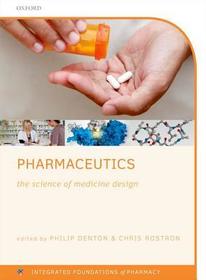
Pharmaceutics: The science of medicine design explores the different forms that medicines can take, and demonstrates how being able to select the best form - be it a tablet, injectable liquid, or an inhaled gas - requires an understanding of how chemicals behave in different physical states.
MoreLong description:
Taking medication is a common occurrence for many people, whether it is to soothe an aching head, regulate blood sugars, or to treat life threatening conditions, such as HIV or cancer. In the UK alone, over 900 million prescriptions are dispensed every year. Overseeing all of this are pharmacists: experts in medicines and their use.
The Integrated Foundations of Pharmacy series supports those who are at the beginning of their journey to become a pharmacist. The reader will begin to understand how a drug molecule is made; the process that turns it into a medicine; the role the pharmacist has when dispensing that medicine; and what happens in the body when it is taken. Most importantly, the series shows how each of these aspects are integrated, reflecting the most up-to-date teaching practices.
Pharmaceutics: The science of medicine design explores the different forms that medicines can take, and demonstrates how being able to select the best form - be it a tablet, injectable liquid, or an inhaled gas - requires an understanding of how chemicals behave in different physical states.
Online Resources
The online resources to accompany Pharmaceutics: the science of medicine design feature:
For registered adopters of the book:
- Figures from the book, available to download.
For students:
- Self-assessment questions to help the reader to check and reinforce understanding of the material introduced in each chapter.
This book will be very useful for first year students. I think what students find difficult with this subject is how to link it together, not only with real life examples but with topics within the subject. This book does this well.
Table of Contents:
Introduction to pharmaceutics
Solids
Liquids
Gases
Thermodynamics
Acids and bases
Phase equilibria and transitions
Partitioning and hydrophobicity
Surface phenomena
Disperse systems
Colligative properties
Kinetics and drug stability
Drug development and delivery

