

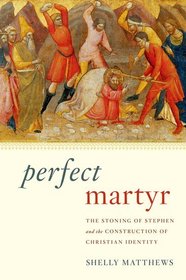
Perfect Martyr
The Stoning of Stephen and the Construction of Christian Identity
- Publisher's listprice GBP 46.99
-
21 215 Ft (20 205 Ft + 5% VAT)
The price is estimated because at the time of ordering we do not know what conversion rates will apply to HUF / product currency when the book arrives. In case HUF is weaker, the price increases slightly, in case HUF is stronger, the price goes lower slightly.
- Discount 10% (cc. 2 121 Ft off)
- Discounted price 19 094 Ft (18 185 Ft + 5% VAT)
Subcribe now and take benefit of a favourable price.
Subscribe
21 215 Ft

Availability
printed on demand
Why don't you give exact delivery time?
Delivery time is estimated on our previous experiences. We give estimations only, because we order from outside Hungary, and the delivery time mainly depends on how quickly the publisher supplies the book. Faster or slower deliveries both happen, but we do our best to supply as quickly as possible.
Product details:
- Publisher OUP USA
- Date of Publication 28 October 2010
- ISBN 9780195393323
- Binding Hardback
- No. of pages240 pages
- Size 160x239x25 mm
- Weight 494 g
- Language English 0
Categories
Short description:
This book analyzes Stephen's perfection, both in terms of rhetorical fittingness, and Christian tradition concerning the significance of his dying forgiveness prayer. It questions the event's historicity, underscores Acts' rhetorical violence, and reads Acts against narratives of the martyrdom of James as a means to a richer history of early Jewish-Christian relations.
MoreLong description:
A number of recent studies have examined martyrdom as a means of identity construction. Shelly Matthews argues that the story of St. Stephen, the first Christian martyr, should be brought into this scholarly conversation. Stephen's story is told in the biblical book of Acts. He has, with near unanimity, been classified as unquestionably a real historical figure, probably because of the narrative coherence and canonical status of the book in which he appears. Matthews points to multiple signals that Stephen functions for Luke (the author of Acts) as a symbolic character. She suggests reframing the Stephen story not in terms of the impossible task of ascertaining "what really happened," but in terms of rhetoric and ethics. All aspects of the Stephen story, she argues, from his name to the manner in which he is killed, are perfectly suited to the rhetorical aims of Luke-Acts. The story undergirds Acts' hostile depiction of the Jews; conforms largely to Roman imperial aims; and introduces radical identity claims of a "marcionite" character. Stephen's role as a typological martyr also explains this 2nd-century text's otherwise eccentric treatment of Christian martyrdom. Matthews juxtaposes the Stephen story with related extra-canonical narratives of the martyrdom of James, thus undercutting the perfect coherence and singularity of the canonical narrative and evoking a more complex historical narrative of violence, solidarity, and resistance among Jews and Christians under empire. Finally, she looks at the traditional reason Stephen is considered the perfect martyr: his dying prayer for the forgiveness of his persecutors. Noting that this prayer was frequently read as idealizing Stephen, while having no effect on those for whom he prayed, she discovers a parallel the Roman discourse of clemency. Any other reading, she says, poses a potentially radical challenge to the cosmic framework of talionic justice, which explains the prayer's complicated reception history.
The big circle of her argument takes up the problems of normatively seeing ourselves as innocent victims, of sanctifying violence, and, specifically, of narrating violent deeds of others as justification for violence. Any who are not uncomfortable about one or more of these issues are not listening. . . . Perfect Martyr is a scholarly book that also faces pressing contemporary issues.
Table of Contents:
Introduction: First Martyr
Situating Acts
Perfect Martyr: Situating Stephen within Acts
Disrupting Acts: Reading Stephen alongside James, the Brother of Jesus
"Father, Forgive Them:" The Place of the Perfect Prayer in the Construction of Christian Identity
Epilogue

