

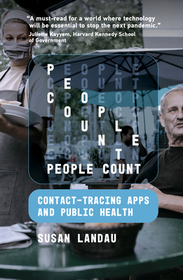
People Count
Contact-Tracing Apps and Public Health
- Publisher's listprice USD 24.95
-
8 776 Ft (8 358 Ft + 5% VAT)
The price is estimated because at the time of ordering we do not know what conversion rates will apply to HUF / product currency when the book arrives. In case HUF is weaker, the price increases slightly, in case HUF is stronger, the price goes lower slightly.
- Discount 8% (cc. 702 Ft off)
- Discounted price 8 074 Ft (7 689 Ft + 5% VAT)
Subcribe now and take benefit of a favourable price.
Subscribe
8 776 Ft

Availability
Only to order.
Why don't you give exact delivery time?
Delivery time is estimated on our previous experiences. We give estimations only, because we order from outside Hungary, and the delivery time mainly depends on how quickly the publisher supplies the book. Faster or slower deliveries both happen, but we do our best to supply as quickly as possible.
Product details:
- Publisher MIT Press
- Date of Publication 6 April 2021
- ISBN 9780262045711
- Binding Hardback
- No. of pages184 pages
- Size 208x137x25 mm
- Weight 340 g
- Language English 101
Categories
Long description:
An introduction to the technology of contact tracing and its usefulness for public health, considering questions of efficacy, equity, and privacy.
How do you stop a pandemic before a vaccine arrives? Contact tracing is key, the first step in a process that has proven effective: trace, test, and isolate. Smartphones can collect some of the information required by contact tracers--not just where you've been but also who's been near you. Can we repurpose the tracking technology that we carry with us--devices with GPS, Wi-Fi, Bluetooth, and social media connectivity--to serve public health in a pandemic? In People Count, cybersecurity expert Susan Landau looks at some of the apps developed for contact tracing during the COVID-19 pandemic, finding that issues of effectiveness and equity intersect.
Landau explains the effectiveness (or ineffectiveness) of a range of technological interventions, including dongles in Singapore that collect proximity information; India's biometric national identity system; Harvard University's experiment, TraceFi; and China's surveillance network. Other nations rejected China-style surveillance in favor of systems based on Bluetooth, GPS, and cell towers, but Landau explains the limitations of these technologies. She also reports that many current apps appear to be premised on a model of middle-class income and a job that can be done remotely. How can they be effective when low-income communities and front-line workers are the ones who are hit hardest by the virus? COVID-19 will not be our last pandemic; we need to get this essential method of infection control right.
"In a pandemic, good science is what we need. Now, a year and a half later, in People Count: Contact Tracing Apps and Public Health, Tufts University professor Susan Landau has set out to make a sober assessment."
ZDNET
"Contact-tracing apps can be a useful tool for public health, but they have considerable false positive and false negative rates."
Big Think
Table of Contents:
Preface
Introduction
1. Stopping a Pandemic
2. Adding Technology to Contact Tracing
3. Protecting Privacy While Tracing Disease
4. Can Contact
-Tracing Apps be Effective Tools of Public Health?
5. Looking to the Long Term
Acknowledgements
Notes
Selected Bibliography
Index

