

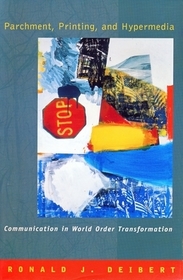
Parchment, Printing, and Hypermedia
Communication and World Order Transformation
Series: New Directions in World Politics;
- Publisher's listprice GBP 35.00
-
15 802 Ft (15 050 Ft + 5% VAT)
The price is estimated because at the time of ordering we do not know what conversion rates will apply to HUF / product currency when the book arrives. In case HUF is weaker, the price increases slightly, in case HUF is stronger, the price goes lower slightly.
- Discount 10% (cc. 1 580 Ft off)
- Discounted price 14 222 Ft (13 545 Ft + 5% VAT)
Subcribe now and take benefit of a favourable price.
Subscribe
15 802 Ft

Availability
Estimated delivery time: In stock at the publisher, but not at Prospero's office. Delivery time approx. 3-5 weeks.
Not in stock at Prospero.
Why don't you give exact delivery time?
Delivery time is estimated on our previous experiences. We give estimations only, because we order from outside Hungary, and the delivery time mainly depends on how quickly the publisher supplies the book. Faster or slower deliveries both happen, but we do our best to supply as quickly as possible.
Product details:
- Publisher Columbia University Press
- Date of Publication 8 October 1997
- ISBN 9780231107136
- Binding Paperback
- No. of pages344 pages
- Size 230 x 152 mm
- Language English 0
Categories
Short description:
Deibert tracks the transformation of Europe from the medieval to the modern and then turns to the hypermedia age, where new digital technologies such as the Internet, encryption, and high-resolution satellite imaging favor nonterritorial institutions and communities, shifting political authority and policymaking from individual nations to transnational corporations, global financial markets, and nongovernmental organizations and activists.
MoreLong description:
Deibert tracks the transformation of Europe from the medieval to the modern and then turns to the hypermedia age, where new digital technologies such as the Internet, encryption, and high-resolution satellite imaging favor nonterritorial institutions and communities, shifting political authority and policymaking from individual nations to transnational corporations, global financial markets, and nongovernmental organizations and activists.
More
