

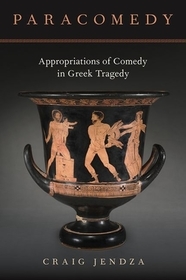
Paracomedy
Appropriations of Comedy in Greek Tragedy
- Publisher's listprice GBP 95.00
-
42 892 Ft (40 850 Ft + 5% VAT)
The price is estimated because at the time of ordering we do not know what conversion rates will apply to HUF / product currency when the book arrives. In case HUF is weaker, the price increases slightly, in case HUF is stronger, the price goes lower slightly.
- Discount 10% (cc. 4 289 Ft off)
- Discounted price 38 603 Ft (36 765 Ft + 5% VAT)
Subcribe now and take benefit of a favourable price.
Subscribe
42 892 Ft

Availability
Only to order.
Why don't you give exact delivery time?
Delivery time is estimated on our previous experiences. We give estimations only, because we order from outside Hungary, and the delivery time mainly depends on how quickly the publisher supplies the book. Faster or slower deliveries both happen, but we do our best to supply as quickly as possible.
Product details:
- Publisher OUP USA
- Date of Publication 22 June 2020
- ISBN 9780190090937
- Binding Hardback
- No. of pages360 pages
- Size 163x236x30 mm
- Weight 680 g
- Language English 0
Categories
Short description:
Paracomedy: Appropriations of Comedy in Greek Drama examines the previously overlooked practice of paracomedy: how ancient Greek tragedians appropriated elements from comedy such as costumes, scenes, plots, or language. Theorizing a new relationship between tragedy and comedy, it redefines how we should understand tragedy and reveals a dynamic theatrical world filled with mutual influence.
MoreLong description:
Paracomedy: Appropriations of Comedy in Greek Drama is the first book that examines how ancient Greek tragedy engages with the genre of comedy. While scholars frequently study paratragedy (how Greek comedians satirize tragedy), this book investigates the previously overlooked practice of paracomedy: how Greek tragedians regularly appropriate elements from comedy such as costumes, scenes, language, characters, or plots. Drawing upon a wide variety of complete and fragmentary tragedies and comedies (Aeschylus, Sophocles, Euripides, Aristophanes, Rhinthon), this monograph demonstrates that paracomedy was a prominent feature of Greek tragedy.
Blending a variety of interdisciplinary approaches including traditional philology, literary criticism, genre theory, and performance studies, this book offers innovative close readings and incisive interpretations of individual plays. Jendza presents paracomedy as a multivalent authorial strategy: some instances impart a sense of ugliness or discomfort; others provide a sense of light-heartedness or humor. While this work traces the development of paracomedy over several hundred years, it focuses on a handful of Euripidean tragedies at the end of the fifth century BCE. Jendza argues that Euripides was participating in a rivalry with the comedian Aristophanes and often used paracomedy to demonstrate the poetic supremacy of tragedy; indeed, some of Euripides' most complex uses of paracomedy attempt to re-appropriate Aristophanes' mockery of his theatrical techniques. Paracomedy: Appropriations of Comedy in Greek Tragedy theorizes a new, ground-breaking relationship between Greek tragedy and comedy that not only redefines our understanding of the genre of tragedy, but also reveals a dynamic theatrical world filled with mutual cross-generic influence.
I found J.'s work stimulating to think with, providing refreshed perspectives on familiar plays and much room for debate... this monograph is a real step forward for exploring intergeneric interactions and the ongoing process of stimulus and response that shaped the development of both comic and tragic drama.
Table of Contents:
Preface
Note to the Reader
Introduction
Chapter 1: Understanding Paracomedy
1.1 The Question of Methodology
1.2 The Question of Motivation
1.3 The Question of Distribution
Chapter 2: Early Paracomedy
2.1 Aeschylus' Oresteia and Old Comedy
2.2 The Paracomic Heracles in Euripides' Alcestis
2.3 The Paracomic Heracles in Euripides' Heracles
2.4 Conclusion
Chapter 3: From Rags to Drag: Paracomic Costuming
3.1 Dressing in Rags: Aristophanes' Acharnians and his Critique of Euripides
3.2 Dressing in Rags: Euripides' Helen and the Re-appropriation of Acharnians
3.3 Dressing in Drag: Aristophanes' Women at the Thesmophoria and his Critique of Euripides
3.4 Dressing in Drag: Euripides' Bacchae and the Re-appropriation of Women at the Thesmophoria
3.5 Conclusion
Chapter 4: Paracomedy and the Structure of Euripides' Helen
4.1 The Structure of Helen
4.2 Phase 1: "Helen", A Play with a Tragic Character (1-385)
4.3 Phase 2: "Menelaus", A Play with a Comic Character (386-527)
4.4 Phase 3: "Helen" vs. "Menelaus", Tragedy vs. Comedy (527-1106)
4.5 Phase 4: "Helen" Victorious (1107-1692)
4.6 Conclusion
Chapter 5: Euripides' Orestes: A Paracomic Play
5.1 The Parodos of Orestes and the Parodos of Peace
5.2 Orestes and Women at the Thesmophoria's Parody of Helen
5.3 Orestes and Women at the Thesmophoria's Parody of Palamedes
5.4 Orestes and Women at the Thesmophoria's Parody of Andromeda
5.5 Orestes and Women at the Thesmophoria's Parody of Telephus
5.6 The Conclusion of Orestes and the Conclusion of Clouds
5.7 Conclusion
Chapter 6: Paracomedy and Relative Chronology
6.1 Paracomedy or Paratragedy?
6.2 Euripides' Antiope and Aristophanes' Women at the Thesmophoria
6.3 Conclusion
Chapter 7: The Aftermath of Paracomedy
7.1 Rhesus and the Imitation of Paracomedy
7.2 Rhinthon's Hilarotragedies
7.3 Pollux's Tragic Parabases
Conclusion
Bibliography
Index Locorum
General Index

