

- Publisher's listprice GBP 69.00
-
31 153 Ft (29 670 Ft + 5% VAT)
The price is estimated because at the time of ordering we do not know what conversion rates will apply to HUF / product currency when the book arrives. In case HUF is weaker, the price increases slightly, in case HUF is stronger, the price goes lower slightly.
- Discount 10% (cc. 3 115 Ft off)
- Discounted price 28 038 Ft (26 703 Ft + 5% VAT)
Subcribe now and take benefit of a favourable price.
Subscribe
31 153 Ft

Availability
printed on demand
Why don't you give exact delivery time?
Delivery time is estimated on our previous experiences. We give estimations only, because we order from outside Hungary, and the delivery time mainly depends on how quickly the publisher supplies the book. Faster or slower deliveries both happen, but we do our best to supply as quickly as possible.
Product details:
- Publisher OUP Oxford
- Date of Publication 6 June 2002
- ISBN 9780199254200
- Binding Paperback
- No. of pages412 pages
- Size 216x139x21 mm
- Weight 511 g
- Language English
- Illustrations 34pp linedrawings and maps 0
Categories
Short description:
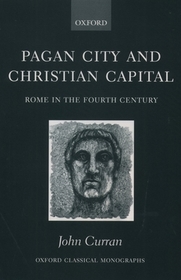
An original and lively study of the transformation of the landscape, civic life, and moral values of the pagan city of Rome following the conversion of the emperor Constantine in the early fourth century. It examines the effects of the rise of Christianity and the decline of paganism in the later Roman empire, which laid the foundation for the capital of medieval Christendom.
MoreLong description:
The critical century between the arrival of Constantine and the advance of Alaric in the early fifth century witnessed dramatic changes in the city of Rome. In this book Dr Curran has broken away from the usual notions of religious conflict between Christians and pagans, to focus on a number of approaches to the Christianization of Rome. He surveys the laws and political considerations which governed the building policy of Constantine and his successors, the effect of papal building and commemorative constructions on Roman topography, the continuing ambivalence of the Roman festal calendar, and the conflict between Christians over asceticism and 'real' Christianity. Thus using analytical, literary, and legal evidence Dr Curran explains the way in which the landscape, civic life, and moral values of Rome were transformed by complex and sometimes paradoxical forces, laying the foundation for the capital of medieval Christendom. Through a study of Rome as a city Dr Curran explores the rise of Christianity and the decline of paganism in the later Roman empire.
a welcome addition to this distinguished series ... the author has new insights to offer in every chapter ... an impressive achievement, a work of great learning and meticulous documentation yet never dull and always readable.
Table of Contents:
Emperors, Gods, and Violence in Third-Century Rome
Conservator Urbis: Maxentius in Rome
Constantine and Rome: The Context of Innovation
The Christianization of the Topography of Rome, AD 337-384
The Legal Standing of the Ancient Cults of Rome
Paganism, Christianity, and the Imperial Celebrations in the Circus Maximus during the Fourth Century
Jerome, Asceticism, and the Roman Aristocracy, AD 340-410
Towards an understanding of 'Christianization' in Rome

