

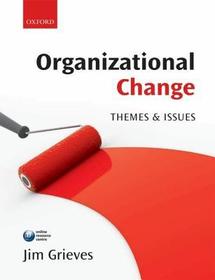
Organizational Change: Themes and Issues
- Publisher's listprice GBP 53.99
-
24 376 Ft (23 215 Ft + 5% VAT)
The price is estimated because at the time of ordering we do not know what conversion rates will apply to HUF / product currency when the book arrives. In case HUF is weaker, the price increases slightly, in case HUF is stronger, the price goes lower slightly.
- Discount 10% (cc. 2 438 Ft off)
- Discounted price 21 938 Ft (20 894 Ft + 5% VAT)
Subcribe now and take benefit of a favourable price.
Subscribe
24 376 Ft

Availability
Out of print
Why don't you give exact delivery time?
Delivery time is estimated on our previous experiences. We give estimations only, because we order from outside Hungary, and the delivery time mainly depends on how quickly the publisher supplies the book. Faster or slower deliveries both happen, but we do our best to supply as quickly as possible.
Product details:
- Edition number 1
- Publisher OUP Oxford
- Date of Publication 11 February 2010
- ISBN 9780199214884
- Binding Paperback
- No. of pages448 pages
- Size 245x189x23 mm
- Weight 783 g
- Language English
- Illustrations 40 illustrations 0
Categories
Short description:
Organizational Change: Themes and Issues presents a critical approach to organizational change, viewing change as a series of critical reflections rather than a series of recipes or models.
MoreLong description:
Organizational Change is the first organizational change text written specifically with post-experience students in mind. It provides the level of theory and critique required at this level, while encouraging readers to reflect and draw upon their own experience of the working world in the 'stop and think' features throughout each chapter. Jim Grieves employs a 'four perspectives' approach to change which runs throughout the book to provide a clear pathway
and overall argument for student learning.
Offering a refreshing thematic approach, the book focusses on key issues such as the ethics of change. The two-part structure (Part 1: Understanding Change and Part 2: Implementing Change) places organizational change in context before guiding students through the key issues to consider in practice.
A full complement of pedagogical features are consistently applied throughout to support students and to ensure they benefit fully from the wide-ranging content. Chapter summaries ensure students have a clear understanding of key points; study questions allow the reader to check their understanding and think around the subject. Exercises encourage students to apply their knowledge to companies with which they are familiar, and longer end-of-chapter cases draw on topical examples featuring
companies such as Northern Rock and Siemens.
Online Resource Centre
For Lecturers:
Diagrams, tables and figures from the text
Guidance notes for the case studies
Teaching and discussion points
For Students:
Web links
Updates to cases
Answers to end of chapter case study questions
References to seminal papers
Links to articles
Very interesting and clearly written; this book explains the key points without overwhelming the student with unnecessary detailed discussion of the schools of thought.
Table of Contents:
Part One: Understanding Change
Perspectives on Change
The Ethics of Organizational Change
Planned Change and its Critics
Strategic Change
Building and Developing Competitive Advantage
Part Two: Implementing Change
Culture and Change
Power, Control and Organizational Change
Leading Change
Diagnosing Organizations
Change Models
Resistance to Change
The Themes and Issues of Future Organizational Change

