

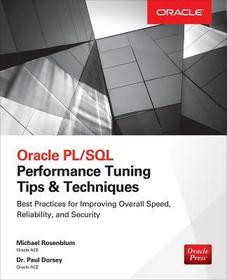
Oracle PL/SQL Performance Tuning Tips & Techniques
Series: DATABASE & ERP - OMG;
- Publisher's listprice GBP 59.99
-
27 085 Ft (25 795 Ft + 5% VAT)
The price is estimated because at the time of ordering we do not know what conversion rates will apply to HUF / product currency when the book arrives. In case HUF is weaker, the price increases slightly, in case HUF is stronger, the price goes lower slightly.
- Discount 10% (cc. 2 709 Ft off)
- Discounted price 24 376 Ft (23 216 Ft + 5% VAT)
Subcribe now and take benefit of a favourable price.
Subscribe
27 085 Ft

Availability
cancelled
Why don't you give exact delivery time?
Delivery time is estimated on our previous experiences. We give estimations only, because we order from outside Hungary, and the delivery time mainly depends on how quickly the publisher supplies the book. Faster or slower deliveries both happen, but we do our best to supply as quickly as possible.
Product details:
- Publisher McGraw Hill
- Date of Publication 16 September 2014
- ISBN 9780071824828
- Binding Paperback
- No. of pages336 pages
- Size 231x188x17 mm
- Weight 572 g
- Language English 0
Categories
Short description:
Oracle ACE authors with decades of experience building complex production systems for government, industry, and educational organizations present a hands-on approach to enabling optimal results from PL/SQL. Real-world examples and best practices are included.
MoreLong description:
Publisher's Note: Products purchased from Third Party sellers are not guaranteed by the publisher for quality, authenticity, or access to any online entitlements included with the product.
Proven PL/SQL Optimization Solutions
In Oracle PL/SQL Performance Tuning Tips & Techniques, Oracle ACE authors with decades of experience building complex production systems for government, industry, and educational organizations present a hands-on approach to enabling optimal results from PL/SQL. The book begins by describing the discovery process required to pinpoint performance problems and then provides measurable and repeatable test cases. In-depth coverage of linking SQL and PL/SQL is followed by deep dives into essential Oracle Database performance tuning tools. Real-world examples and best practices are included throughout this Oracle Press guide.
- Follow a request-driven nine-step process to identify and address performance problems in web applications
- Use performance-related database tools, including data dictionary views, logging, tracing, PL/SQL Hierarchical Profiler, PL/Scope, and RUNSTATS
- Instrument code to pinpoint performance issues using call stack APIs, error stack APIs, and timing markers
- Embed PL/SQL in SQL and manage user-defined functions
- Embed SQL in PL/SQL using a set-based approach to handle large volumes of data
- Properly write and deploy data manipulation language triggers to avoid performance problems
- Work with advanced datatypes, including LOBs and XML
- Use caching techniques to avoid redundant operations
- Effectively use dynamic SQL to reduce the amount of code needed and streamline system management
- Manage version control and ensure that performance fixes are successfully deployed
Code examples in the book are available for download.
Publisher's Note: Products purchased from Third Party sellers are not guaranteed by the publisher for quality, authenticity, or access to any online entitlements included with the product.
Proven PL/SQL Optimization Solutions
In Oracle PL/SQL Performance Tuning Tips & Techniques, Oracle ACE authors with decades of experience building complex production systems for government, industry, and educational organizations present a hands-on approach to enabling optimal results from PL/SQL. The book begins by describing the discovery process required to pinpoint performance problems and then provides measurable and repeatable test cases. In-depth coverage of linking SQL and PL/SQL is followed by deep dives into essential Oracle Database performance tuning tools. Real-world examples and best practices are included throughout this Oracle Press guide.
- Follow a request-driven nine-step process to identify and address performance problems in web applications
- Use performance-related database tools, including data dictionary views, logging, tracing, PL/SQL Hierarchical Profiler, PL/Scope, and RUNSTATS
- Instrument code to pinpoint performance issues using call stack APIs, error stack APIs, and timing markers
- Embed PL/SQL in SQL and manage user-defined functions
- Embed SQL in PL/SQL using a set-based approach to handle large volumes of data
- Properly write and deploy data manipulation language triggers to avoid performance problems
- Work with advanced datatypes, including LOBs and XML
- Use caching techniques to avoid redundant operations
- Effectively use dynamic SQL to reduce the amount of code needed and streamline system management
- Manage version control and ensure that performance fixes are successfully deployed
Code examples in the book are available for download.
MoreTable of Contents:
Part 1. Core ideas and elements of PL/SQL performance tuning
Introduction. Chapter 1. Role of PL/SQL in contemporary development
Chapter 2. DBA/Developer borderline: tools/features/setup
Chapter 3. Code instrumentation in PL/SQL
Part 2. Linking SQL and PL/SQL
Chapter 4. Expanding the SQL Horizons
Chapter 5. Thinking in sets
Chapter 6. Pulling the Trigger
Part 3. Tuner's Toolkit
Chapter 7. Going beyond scalar datatypes
Chapter 8. Keeping the cache
Chapter 9. Shooting at a moving target
Part4. PL/SQL in daily life
Chapter 10. Tales from the trenches
Chapter 11. Code management in real world systems
Chapter 12. Extra tips, tricks and ideas

