

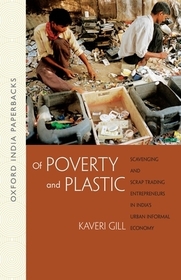
Of Poverty and Plastic
Scavenging and Scrap Trading Entrepreneurs in India's Urban Informal Economy
- Publisher's listprice GBP 7.99
-
3 607 Ft (3 435 Ft + 5% VAT)
The price is estimated because at the time of ordering we do not know what conversion rates will apply to HUF / product currency when the book arrives. In case HUF is weaker, the price increases slightly, in case HUF is stronger, the price goes lower slightly.
- Discount 10% (cc. 361 Ft off)
- Discounted price 3 246 Ft (3 092 Ft + 5% VAT)
Subcribe now and take benefit of a favourable price.
Subscribe
3 607 Ft

Availability
Uncertain availability. Please turn to our customer service.
Why don't you give exact delivery time?
Delivery time is estimated on our previous experiences. We give estimations only, because we order from outside Hungary, and the delivery time mainly depends on how quickly the publisher supplies the book. Faster or slower deliveries both happen, but we do our best to supply as quickly as possible.
Product details:
- Publisher OUP India
- Date of Publication 18 October 2012
- ISBN 9780198085508
- Binding Paperback
- No. of pages308 pages
- Size 215x141x17 mm
- Weight 306 g
- Language English
- Illustrations 6 b/w photographs, 1 map 0
Categories
Short description:
This book documents and analyses the various facets of labouring lives at different levels of the value chain in the waste scavenging and plastic recycling sector. It links the economic, social, and political factors that structure the well-being, agency, and activities of actors operating in this informal economy.
MoreLong description:
This volume applies the interdisciplinary 'field economics' approach to poverty analysis. The work is based on extensive fieldwork in the pre-urban edge of the sprawling metropolis of Delhi It assesses the economic, social, and political institutions and processes that structure the well-being, agency, and activities of the poor who are waste scavengers and involved with plastic recycling.
Using a mix of survey and ethnographic data, it tells the complete story of how the waste picker at the lowest level of the chain fares in comparison to other kinds of occupational groups engaged in different parts of the scavenging and recycling chain, as well as in other parts of the informal economy. It focuses on the following themes: how occupational choices are dictated by low caste status; how these groups negotiate and surmount market failures and state failures to create a viable
informal economy supporting numerous livelihoods and businesses; and how these groups gain or lose from patronage links at the level of the state government and national political parties.
Table of Contents:
List of Photographs
List of Tables
Figures, and Boxes
Foreword
Acknowledgements
List of Abbreviations
Introduction
The City of Delhi
Waste as Informal Sector Work: Measuring Income Poverty, Inequality, and Deprivation
Interlinked Contracts and Social Power: Patronage and Exploitation in the Waste Recovery Market
Exploitation or Entrepreneurship? Scrap Traders and the Economics of Survival in the Informal Economy
From Pigs and Pollution to Plastics and Progress: Recasting Low Caste Status through an Informal Market
'Bourgeois Environmentalism', the State, the Judiciary, and the Urban Poor: The Political Mobilization of a Scheduled Caste Market;
Conclusion
Appendix
Plastics
Bibliography
Index

