

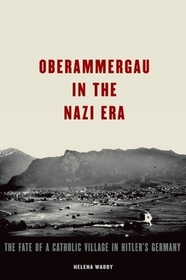
Oberammergau in the Nazi Era
The Fate of a Catholic Village in Hitler's Germany
- Publisher's listprice GBP 69.00
-
31 153 Ft (29 670 Ft + 5% VAT)
The price is estimated because at the time of ordering we do not know what conversion rates will apply to HUF / product currency when the book arrives. In case HUF is weaker, the price increases slightly, in case HUF is stronger, the price goes lower slightly.
- Discount 10% (cc. 3 115 Ft off)
- Discounted price 28 038 Ft (26 703 Ft + 5% VAT)
Subcribe now and take benefit of a favourable price.
Subscribe
31 153 Ft

Availability
printed on demand
Why don't you give exact delivery time?
Delivery time is estimated on our previous experiences. We give estimations only, because we order from outside Hungary, and the delivery time mainly depends on how quickly the publisher supplies the book. Faster or slower deliveries both happen, but we do our best to supply as quickly as possible.
Product details:
- Publisher OUP USA
- Date of Publication 15 July 2010
- ISBN 9780195371277
- Binding Hardback
- No. of pages352 pages
- Size 160x236x30 mm
- Weight 646 g
- Language English
- Illustrations 23 illustrations 0
Categories
Short description:
In her study of Oberammergau, the Bavarian village famous for its decennial passion play, Helena Waddy argues against the traditional image of the village as a Nazi stronghold. She uses Oberammergau's unique history to explain why and how genuinely some villagers chose to become Nazis, while others rejected Party membership and defended their Catholic lifestyle. She explores the reasons for which both local Nazis and their opponents fought to protect the village's cherished identity against the Third Reich's many intrusive demands. She also shows that the play mirrored the Gospel-based anti-Semitism endemic to Western culture.
MoreLong description:
The Bavarian mountain village of Oberammergau is famous for its decennial passion play. The play began as an articulation of the villagers' strong Catholic piety, but in the late 19th and early 20th centuries developed into a considerable commercial enterprise. The growth of the passion play from a curiosity of village piety into a major tourist attraction encouraged all manner of entrepreneurial behavior and brought the inhabitants of this isolated rural area into close contract with a larger world. Hundreds of thousands of tourists came to see the play, and thousands of temporary workers descended on the village during the play season, some settling permanently in Oberammergau. Adolf Hitler would attend a performance of the play in 1934, later saying that the drama "revealed the muck and mire of Jewry." But, Helena Waddy argues, it is a mistake to brand Oberammergau as a Nazi stronghold, as has commonly been done. In this book she uses Oberammergau's unique history to explain why and how genuinely some villagers chose to become Nazis, while others rejected Party membership and defended their Catholic lifestyle. She explores the reasons why both local Nazis and their opponents fought to protect the village's cherished identity against the Third Reich's many intrusive demands. On the other hand, she also shows that the play mirrored the Gospel-based anti-Semitism endemic to Western culture. As a local study of the rise of Nazism and the Nazi era, Waddy's work is an important contribution to a growing genre. As a collective biography, it is a fascinating and moving portrait of life at a time when, as Thomas Mann wrote, "every day hurled the wildest demands at the heart and brain."
Helena Waddy offers a rich and detailed examination of the uneasy interaction of Naziism with the village's heritage and the Catholic piety which nourished it.
Table of Contents:
Contents
Introduction
Catholics
Voters
Nazis
Joiners
Players
Leaders
Warriors
Allies
Conclusions
Abbreviations
Notes
Acknowledgments
Illustration Credits
Central File
Bibliography
Index

