

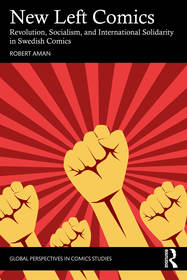
New Left Comics
Revolution, Socialism, and International Solidarity in Swedish Comics
Series: Global Perspectives in Comics Studies;
- Publisher's listprice GBP 41.99
-
18 958 Ft (18 055 Ft + 5% VAT)
The price is estimated because at the time of ordering we do not know what conversion rates will apply to HUF / product currency when the book arrives. In case HUF is weaker, the price increases slightly, in case HUF is stronger, the price goes lower slightly.
- Discount 20% (cc. 3 792 Ft off)
- Discounted price 15 166 Ft (14 444 Ft + 5% VAT)
- Discount is valid until: 30 June 2026
Subcribe now and take benefit of a favourable price.
Subscribe
17 062 Ft

Availability
Estimated delivery time: In stock at the publisher, but not at Prospero's office. Delivery time approx. 3-5 weeks.
Not in stock at Prospero.
Why don't you give exact delivery time?
Delivery time is estimated on our previous experiences. We give estimations only, because we order from outside Hungary, and the delivery time mainly depends on how quickly the publisher supplies the book. Faster or slower deliveries both happen, but we do our best to supply as quickly as possible.
Product details:
- Edition number 1
- Publisher Routledge India
- Date of Publication 11 March 2026
- ISBN 9781032972466
- Binding Paperback
- No. of pages138 pages
- Size 234x156 mm
- Weight 260 g
- Language English
- Illustrations 31 Illustrations, black & white; 31 Halftones, black & white 686
Categories
Short description:
New Left Comics examines the leftist radicalization in Sweden during the decade immediately succeeding 1968 through the lens of comic books. It uncovers the ways in which writers and artists used mainstream comics as a medium to teach and inform readers about various forms of injustices and inequality.
MoreLong description:
Why does Johan Vilde testify about Sweden’s involvement in the transatlantic slave trade? Why do the young Stockholm sons, Stefan and Sacho, in Mystiska 2:an discuss class society and commercialism on their way back home from school? And why does the Phantom start a co-operative society in the jungle and act as a mouthpiece for Prime Minister Olof Palme? And in reverse: why is it almost impossible to imagine Spider-Man, Tintin, or Archie ruminating about trade union issues, gender equality on the labour market, or taking a stand against the apartheid regimes in Southern Africa?
New Left Comics examines the leftist radicalisation in Sweden during the decade immediately succeeding 1968 through the lens of comic books. It looks at four of the most popular and widely read comic books and graphic novels—Johan Vilde, Tumac, Mystiska 2:an, and The Phantom—between 1968 and 1980, and uncovers the ways in which writers and artists used mainstream comics as a medium to teach and inform readers about various forms of injustices and inequality—as well as utopian futures—by adding social, political, and economic comments.
This topical and engaging volume in the Global Perspectives in Comics Studies series will be of interest to researchers and students of comics studies, literary studies, visual art studies, cultural studies, media studies, and sociology. It will also be useful reading for a wider academic audience interested in discourses around world politics, politics and media, politics and popular culture, and comics traditions.
'Robert Aman’s eye-opening monograph New Left Comics documents a peculiar chapter of Sweden’s 1970s cultural history—best-selling left-wing comics series whose mass appeal was rooted in the country’s post-1968 ideological mainstreaming of social justice and Third-Worldism.'
- Jean-Paul Gabilliet, Professor of Comics History, University of Bordeaux Montaigne
MoreTable of Contents:
Lists of figures. Preface. Acknowledgement. 1. Introduction 2. The Phantom and Foreign Aid 3. Johan Vilde and Colourblind Anti-racism 4. Tumac and the Revolution 5. Mystiska 2:an and the Underside of the Welfare state 6. Conclusion. References. Index.
More
