

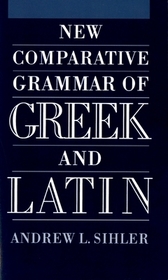
New Comparative Grammar of Greek and Latin
- Publisher's listprice GBP 67.00
-
30 250 Ft (28 810 Ft + 5% VAT)
The price is estimated because at the time of ordering we do not know what conversion rates will apply to HUF / product currency when the book arrives. In case HUF is weaker, the price increases slightly, in case HUF is stronger, the price goes lower slightly.
- Discount 10% (cc. 3 025 Ft off)
- Discounted price 27 225 Ft (25 929 Ft + 5% VAT)
Subcribe now and take benefit of a favourable price.
Subscribe
30 250 Ft

Availability
printed on demand
Why don't you give exact delivery time?
Delivery time is estimated on our previous experiences. We give estimations only, because we order from outside Hungary, and the delivery time mainly depends on how quickly the publisher supplies the book. Faster or slower deliveries both happen, but we do our best to supply as quickly as possible.
Product details:
- Publisher OUP USA
- Date of Publication 27 November 2008
- ISBN 9780195373363
- Binding Paperback
- No. of pages720 pages
- Size 229x155x35 mm
- Weight 1021 g
- Language English 0
Categories
Long description:
Like Carl Darling Buck's Comparative Grammar of Greek and Latin (1933), this book is an explanation of the similarities and differences between Greek and Latin morphology and lexicon through an account of their prehistory. It also aims to discuss the principal features of Indo-European linguistics. Greek and Latin are studied as a pair for cultural reasons only; as languages, they have little in common apart from their Indo-European heritage. Thus the only way to treat the historical bases for their development is to begin with Proto-Indo-European. The only way to make a reconstructed language like Proto-Indo-European intelligible and intellectually defensible is to present at least some of the basis for reconstructing its features and, in the process, to discuss reasoning and methodology of reconstruction (including a weighing of alternative reconstructions). The result is a compendious handbook of Indo-European phonology and morphology, and a vade mecum of Indo-European linguistics - the focus always remaining on Greek and Latin. The non-classical sources for historical discussion are mainly Vedic Sanskrit, Hittite, and Germanic, with occasional but crucial contributions from Old Irish, Avestan, Baltic, and Slavic.
MoreTable of Contents:
Abbreviations
PART I: Introduction
The Indo-European Family of Languages
Greek
Latin and the Italic Languages
The Greek and Latin Signaries
Notes on Citation and Transcription
PART II: Phonology
Vowels and Dipthongs
Vowel Gradation
Consonants
Stops
Laryngeals
Pie
Liquids, Nasals, and Changes in Groups of Consonants
Accent
PART III: Declension
Parts of Speech
Indo-European Nominals
Nouns
Declension of Adjectives
Comparison of Adjectives
PART IV: Pronouns
Personal Pronouns
Demonstrative Interrogative
PART V: Numerals
Prepositions
PART VI: Conjugation
Survey of the Pie System
Eventive Verbs
Present Classes in Greek
Present Classes in Latin
The Verb 'Be' in Greek and Latin
Durative Eventive Preterite
Future
Punctual Eventive
Stative Verbs
Moods in Proto-Indo-European
Non-Finite Forms
Indexes

