

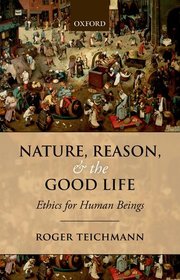
Nature, Reason, and the Good Life
Ethics for Human Beings
- Publisher's listprice GBP 30.49
-
14 566 Ft (13 872 Ft + 5% VAT)
The price is estimated because at the time of ordering we do not know what conversion rates will apply to HUF / product currency when the book arrives. In case HUF is weaker, the price increases slightly, in case HUF is stronger, the price goes lower slightly.
- Discount 10% (cc. 1 457 Ft off)
- Discounted price 13 109 Ft (12 485 Ft + 5% VAT)
Subcribe now and take benefit of a favourable price.
Subscribe
14 566 Ft

Availability
printed on demand
Why don't you give exact delivery time?
Delivery time is estimated on our previous experiences. We give estimations only, because we order from outside Hungary, and the delivery time mainly depends on how quickly the publisher supplies the book. Faster or slower deliveries both happen, but we do our best to supply as quickly as possible.
Product details:
- Publisher OUP Oxford
- Date of Publication 2 October 2014
- ISBN 9780198708971
- Binding Paperback
- No. of pages210 pages
- Size 215x142x11 mm
- Weight 236 g
- Language English 0
Categories
Short description:
At the centre of our ethical thought stands the human being. Roger Teichmann examines the ways in which facts about human nature determine the shape of ethical concepts such as rationality, virtue, and happiness. He argues that only by attending to the social and empirical character of language use can we address a number of problems in ethics.
MoreLong description:
At the centre of our ethical thought stands the human being. Facts about human nature determine the shape of ethical concepts in a variety of ways, and our pre-rational animal nature forms the basis of notions to do with rationality, virtue, and happiness, among other things. Nature, Reason, and the Good Life examines these themes while also arguing for the critical importance of language: only by attending to the social and empirical character of actual language use can we make headway with a number of problems in ethics. Thus what counts as a good or bad reason for action depends on the purposes of human enquiry, as embodied in the question 'Why?'--it does not depend, for example, on some abstract and higher Rationality connected with 'the point of the cosmos'. Furthermore, considerations in philosophy of language and in philosophy of mind together show how emotions, desires, and pleasure--all crucial for ethics--turn out not to be inner states carrying a sort of subjective authority, above or below criticism or justification, and this fact helps undermine various forms of subjectivism and individualism to be found both in philosophy and in the wider culture. Starting from an examination of foundational issues, the book covers a range of topics, including animals, agency, enjoyment, the good life, contemplation, death, and the importance of philosophy. En route, there are critiques of a number of prevalent trends of thought, such as utilitarianism, anti-speciesism, relativism, scientism and even 'ism'-ism.
This is a rich, interesting, and engaging work. It is well-written, forthright, helpfully signposted, always letting readers know what the argument is and what the reasons are for it.
Table of Contents:
Introduction
Reasons and Reactions
Human Agency
Pleasure and Pain
The Good Life
Philosophy
References
Index

