

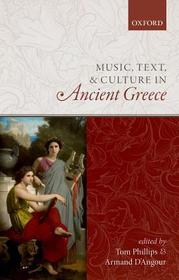
Music, Text, and Culture in Ancient Greece
- Publisher's listprice GBP 107.50
-
51 358 Ft (48 912 Ft + 5% VAT)
The price is estimated because at the time of ordering we do not know what conversion rates will apply to HUF / product currency when the book arrives. In case HUF is weaker, the price increases slightly, in case HUF is stronger, the price goes lower slightly.
- Discount 10% (cc. 5 136 Ft off)
- Discounted price 46 222 Ft (44 021 Ft + 5% VAT)
Subcribe now and take benefit of a favourable price.
Subscribe
51 358 Ft

Availability
printed on demand
Why don't you give exact delivery time?
Delivery time is estimated on our previous experiences. We give estimations only, because we order from outside Hungary, and the delivery time mainly depends on how quickly the publisher supplies the book. Faster or slower deliveries both happen, but we do our best to supply as quickly as possible.
Product details:
- Publisher OUP Oxford
- Date of Publication 29 March 2018
- ISBN 9780198794462
- Binding Hardback
- No. of pages294 pages
- Size 219x148x22 mm
- Weight 498 g
- Language English
- Illustrations 6 black-and-white figures 0
Categories
Short description:
What difference does music make to performance poetry, and how did the ancients understand this relationship? This volume explores the interaction of music and language in ancient Greek poetry, arguing that music crucially informs the ways in which these texts create meaning and exploring its place in contemporary critical writings.
MoreLong description:
What difference does music make to performance poetry, and how did the ancients themselves understand this relationship? Although scholars have long recognized the importance of music to ancient performance culture, little has been written on the specific effects that musical accompaniment, and features such as rhythmical structure and melody, would have created in individual poems.
This volume attempts to answer these questions by exploring more fully the relationship between music and language in the poetry of ancient Greece. Arranged into two parts, the essays in the first half engage closely with the evidential and interpretative challenges posed by the interaction of ancient music and poetry, and propose original readings of a range of texts by authors such as Homer, Pindar, and Euripides, as well as later poets such as Seikilos and Mesomedes. While they emphasize different formal features, they also argue collectively for a two-way relationship between music and language: attention to the musical features of poetic texts, insofar as we can reconstruct them, enables us to better understand not only their effects on audiences, but also the various ways in which they project and structure meaning.
In the second part, the focus shifts to ancient attempts to conceptualize interactions between words and music; the essays in this section analyse the contested place that music occupied in the works of Plato, Aristotle, Plutarch, and other critical writers of the Hellenistic and Imperial periods. Thinking about music is shown to influence other domains of intellectual life, such as literary criticism, and to be vitally informed by ethical concerns. These essays illustrate the importance of music for intellectual culture in ancient Greece and the ancients' abiding concern to understand and control its effects on human behaviour.
On the whole, the volume offers a good variety of interpretative approaches and fresh insights into poetical, philosophical and rhetorical texts...
Table of Contents:
Frontmatter
List of Figures
List of Abbreviations
List of Contributors
Introduction: Music, Text, and Culture
I: Interpretation
Epicentric Tonality and the Greek Lyric Tradition
The Musical Setting of Ancient Greek Texts
Words and the Musician: Pindar's Dactylo-Epitrites
Music in Euripides' Medea
Mesomedes' Hymn to the Sun: The Precipitation of Logos in the Melos
II: Theory, Reception, Contexts
Hearing the Syrinx in Euripidean Tragedy
Lyric Atmospheres: Plato and Mimetic Evanescence
Aristotle on Music for Leisure
Sounds You Cannot Hear: Cicero and the Tradition of Sublime Criticism
Disreputable Music: A Performance, a Defence, and their Intertextual and Intermedial Resonances (Plutarch Quaest. conv. 704c4-705b6)
Endmatter
Bibliography
Index

