

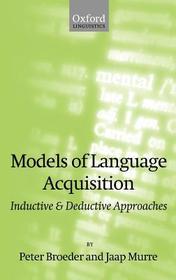
Models of Language Acquisition
Inductive and Deductive Approaches
- Publisher's listprice GBP 215.00
-
97 072 Ft (92 450 Ft + 5% VAT)
The price is estimated because at the time of ordering we do not know what conversion rates will apply to HUF / product currency when the book arrives. In case HUF is weaker, the price increases slightly, in case HUF is stronger, the price goes lower slightly.
- Discount 10% (cc. 9 707 Ft off)
- Discounted price 87 365 Ft (83 205 Ft + 5% VAT)
Subcribe now and take benefit of a favourable price.
Subscribe
97 072 Ft

Availability
printed on demand
Why don't you give exact delivery time?
Delivery time is estimated on our previous experiences. We give estimations only, because we order from outside Hungary, and the delivery time mainly depends on how quickly the publisher supplies the book. Faster or slower deliveries both happen, but we do our best to supply as quickly as possible.
Product details:
- Publisher OUP Oxford
- Date of Publication 16 November 2000
- ISBN 9780198299899
- Binding Hardback
- No. of pages301 pages
- Size 243x163x21 mm
- Weight 587 g
- Language English
- Illustrations numerous black and white line figures 0
Categories
Short description:
This book presents recent advances by leading researchers in computational modelling of language acquisition. The contributors have been drawn from departments of linguistics, cognitive science, psychology, and computer science. They show what light can be thrown on fundamental problems when powerful computational techniques are combined with real data. The book considers the extent to which linguistic structure is readily available in the environment, the degree to which language learning is inductive or deductive, and the power of different modelling formalisms for different problems and approaches. It will appeal to linguists, psychologists, cognitive scientists working in language acquisition,and to those involved in computational modelling in linguistic and behavioural science.
MoreLong description:
This book presents recent advances by leading researchers in computational modelling of language acquisition. Sophisticated theoretical models can now be tested using simulation techniques and large corpora of linguistic data. Renewed interest in learning neural networks and the ability to test new solutions to fundamental problems has fuelled debates in an already very active field. The twenty-four authors in this collection of new work have been drawn from departments of linguistics, cognitive science, psychology, and computer science. The book as a whole shows what light may be thrown on fundamental problems when powerful computational techniques are combined with real data
A central question addressed in the book concerns the extent to which linguistic structure is readily available in the environment. The authors consider the evidence in relation to word boundaries and phonotactic structure, stress patterns, text-to-speech rules, and the mapping of lexical semantics, one author arguing that a childs own output may serve as a key source of linguistic input. Linguistic structure-environment relations are central to the debate on the degree to which language learning is inductive or deductive: this issue is considered here in studies of the acquisition of pluralization and inflectional morphology.
The book examines the power and utility of different modeling formalisms for different problems and approaches: how far, for example, can connectionist models be used as models for language acquisition or Simple Recurrent Networks form the basis of a model of language acquisition? To what degree can lexical items and categories be used in the construction of neural network models, or Markov chains be deployed to investigate the characteristics of a general language learning algorithm (Triggering Learning Algorithm)?
This book will appeal to linguists, psychologists, cognitive scientists working in language acquisition. It will also interest those involved in computational modelling in linguistics and behavioural science.
This is a volume which fairly depicts the field that it represents.
Table of Contents:
Chapter 1: Introduction
Part I: Words
Chapter 2: Lexicalist Connectionism
Chapter 3: Are SRNs Sufficient for Modelling Language Acquisition?
Chapter 4: A Distributed, Yet Symbolic Model for Text-to-Speech Processing
Chapter 5: "Lazy Learning": A Comparison of Natural and Machine Learning of Word Stress
Part II: Word Formation
Chapter 6: Statistical and Connectionist Modelling of the Development of Speech Segmentation
Chapter 7: Learning Word-to-Meaning Mappings
Chapter 8: Children's Overregularization and its Implication for Cognition
Chapter 9: The Performance of a Recurrent Network with Short Term Memory Capacity Learning the German -S Plural
Chapter 19: A Cross-Linguistic Comparison of Single and Dual-Route Models of Inflectional Morphology
Part III: Word Order
Chapter 11: Formal Models for Learning in the Principles and Parameters Framework
Chapter 12: An Output-as-Input Hypothesis for Language Acquisition: Arguments, Model, Evidence

