

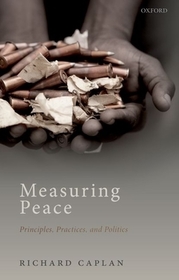
Measuring Peace
Principles, Practices, and Politics
- Publisher's listprice GBP 25.49
-
11 508 Ft (10 960 Ft + 5% VAT)
The price is estimated because at the time of ordering we do not know what conversion rates will apply to HUF / product currency when the book arrives. In case HUF is weaker, the price increases slightly, in case HUF is stronger, the price goes lower slightly.
- Discount 20% (cc. 2 302 Ft off)
- Discounted price 9 206 Ft (8 768 Ft + 5% VAT)
- Discount is valid until: 30 June 2026
Subcribe now and take benefit of a favourable price.
Subscribe
11 508 Ft

Availability
Estimated delivery time: In stock at the publisher, but not at Prospero's office. Delivery time approx. 3-5 weeks.
Not in stock at Prospero.
Why don't you give exact delivery time?
Delivery time is estimated on our previous experiences. We give estimations only, because we order from outside Hungary, and the delivery time mainly depends on how quickly the publisher supplies the book. Faster or slower deliveries both happen, but we do our best to supply as quickly as possible.
Product details:
- Publisher OUP Oxford
- Date of Publication 15 June 2021
- ISBN 9780198867708
- Binding Paperback
- No. of pages176 pages
- Size 216x137x10 mm
- Weight 230 g
- Language English 104
Categories
Short description:
An essential and accessible guide to the assessment of the effectiveness of peace-building policies for all those working in, or studying, the area.
MoreLong description:
How can we know if the peace that has been established following a civil war is a stable peace?
More than half of all countries that experienced civil war since World War II have suffered a relapse into violent conflict, in some cases more than once. Meanwhile, the international community expends billions of dollars and deploys tens of thousands of personnel each year in support of efforts to build peace in countries emerging from violent conflict.
This book argues that efforts to build peace are hampered by the lack of effective means of assessing progress towards the achievement of a consolidated peace. Rarely, if ever, do peacebuilding organizations and governments seek to ascertain the quality of the peace that they are helping to build and the contribution that their engagement is making (or not) to the consolidation of peace. More rigorous assessments of the robustness of peace are needed. These assessments require clarity about the characteristics of, and the requirements for, a stable peace. This in turn requires knowledge of the local culture, local history, and the specific conflict dynamics at work in a given conflict situation. Better assessment can inform peacebuilding actors in the reconfiguration and reprioritization of their operations in cases where conditions on the ground have deteriorated or improved. To build a stable peace, it is argued here, it is important to take the measure of peace.
For academics, this book is a welcome addition to scholarship that has long sought to understand the impact that peacebuilding may or may not have on creating a stable peace. For practitioners, it will help them become more rigorous in finding definitions even when they appear elusive and provides valuable insight into which strategic assessment and measurement tools are working for leaders in the peacebuilding industry.
Table of Contents:
Introduction
Conceptualizing Peace
From Conception to Practice
Assessing Progress
Factors of Post-Conflict Peace Stabilization
Measuring Peace Consolidation
Conclusion

