

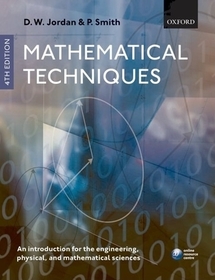
Mathematical Techniques
An Introduction for the Engineering, Physical, and Mathematical Sciences
- Publisher's listprice GBP 71.99
-
32 503 Ft (30 955 Ft + 5% VAT)
The price is estimated because at the time of ordering we do not know what conversion rates will apply to HUF / product currency when the book arrives. In case HUF is weaker, the price increases slightly, in case HUF is stronger, the price goes lower slightly.
- Discount 10% (cc. 3 250 Ft off)
- Discounted price 29 252 Ft (27 860 Ft + 5% VAT)
Subcribe now and take benefit of a favourable price.
Subscribe
32 503 Ft

Availability
printed on demand
Why don't you give exact delivery time?
Delivery time is estimated on our previous experiences. We give estimations only, because we order from outside Hungary, and the delivery time mainly depends on how quickly the publisher supplies the book. Faster or slower deliveries both happen, but we do our best to supply as quickly as possible.
Product details:
- Edition number 4
- Publisher OUP Oxford
- Date of Publication 13 March 2008
- ISBN 9780199282012
- Binding Paperback
- No. of pages1008 pages
- Size 246x190x47 mm
- Weight 1980 g
- Language English
- Illustrations 500 figures 0
Categories
Short description:
Mathematical Techniques provides a complete course in mathematics, covering all the essential topics with which a physical sciences or engineering student should be familiar. It introduces and builds on concepts in a progressive, carefully-layered way, and features over 2000 end of chapter problems, plus additional self-check questions.
MoreLong description:
Mathematical concepts and theories underpin much of the physical sciences and engineering. Yet maths is a subject that many students find challenging, and even intimidating - despite it being so central to their field of study.
Mathematical Techniques provides a complete course in mathematics, covering all the essential topics with which a physical sciences or engineering student should be familiar.
By breaking the subject into small, modular chapters, the book introduces and builds on concepts in a progressive, carefully-layered way - always with an emphasis on how to use the power of maths to best effect, rather than on theoretical proofs of the maths presented.
With a huge array of end of chapter problems, and new self-check questions, the fourth edition of Mathematical Techniques provides extensive opportunities for students to build their confidence in the best way possible: by using the maths for themselves.
Online Resources
The online resources feature the following materials for all users of the book:
· Figures from the book in electronic format, ready to download
· A downloadable solutions manual, featuring worked solutions to all end of chapter problems
· Mathematica-based programs, relating to the Projects featured at the end of the book
Review from previous edition This textbook offers an accessible and comprehensive grounding in many of the mathematical techniques required in the early stages of an engineering or science degree and also for the routine methods needed by first and second year mathematics students.
Table of Contents:
PART 1. ELEMENTARY METHODS, DIFFERENTIATION, COMPLEX NUMBERS
Standard functions and techniques
Differentiation
Further techniques for differentiation
Applications of differentiation
Taylor series and approximations
Complex numbers
PART 2. MATRIX AND VECTOR ALGEBRA
Matrix algebra
Determinants
Elementary operations with vectors
The scalar product
Vector product
Linear algebraic equations
Eigenvalues and eigenvectors
PART 3. INTEGRATION AND DIFFERENTIAL EQUATIONS
Antidifferentiation and area
The definite and indefinite integral
Applications involving the integral as a sum
Systematic techniques for integration
Unforced linear differential equations with constant coefficients
Forced linear differential equations
Harmonic functions and the harmonic oscillator
Steady forced oscillations: phasors, impedance, transfer functions
Graphical, numerical, and other aspects of first-order equations
Nonlinear differential equations and the phase plane
PART 4. TRANSFORMS AND FOURIER SERIES
The Laplace transform
Laplace and z transforms: applications
Fourier series
Fourier transforms
PART 5. MULTIVARIABLE CALCULUS
Differentiation of functions of two variables
Functions of two variables: geometry and formulae
Chain rules, restricted maxima, coordinate systems
Functions of any number of variables
Double integration
Line integrals
Vector fields: divergence and curl
PART 6. DISCRETE MATHEMATICS
Sets
Boolean algebra: logic gates and switching functions
Graph theory and its applications
Difference equations
PART 7. PROBABILITY AND STATISTICS
Probability
Random variables and probability distributions
Descriptive statistics
PART 8. PROJECTS
Applications projects using symbolic computing
Self-tests: selected answers
Answers to selected problems
Appendices
Further reading
Index

