

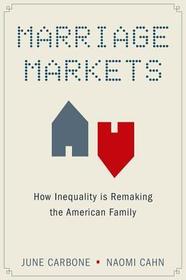
Marriage Markets
How Inequality is Remaking the American Family
- Publisher's listprice GBP 23.49
-
10 605 Ft (10 100 Ft + 5% VAT)
The price is estimated because at the time of ordering we do not know what conversion rates will apply to HUF / product currency when the book arrives. In case HUF is weaker, the price increases slightly, in case HUF is stronger, the price goes lower slightly.
- Discount 10% (cc. 1 061 Ft off)
- Discounted price 9 545 Ft (9 090 Ft + 5% VAT)
Subcribe now and take benefit of a favourable price.
Subscribe
10 605 Ft

Availability
printed on demand
Why don't you give exact delivery time?
Delivery time is estimated on our previous experiences. We give estimations only, because we order from outside Hungary, and the delivery time mainly depends on how quickly the publisher supplies the book. Faster or slower deliveries both happen, but we do our best to supply as quickly as possible.
Product details:
- Publisher OUP USA
- Date of Publication 12 November 2015
- ISBN 9780190263317
- Binding Paperback
- No. of pages268 pages
- Size 231x155x22 mm
- Weight 363 g
- Language English 0
Categories
Short description:
In this rigorous and enlightening account of why American families have transformed so much since the 1960s, two leading scholars of family law argue that the changing economy, rather than changing morals, is at the root of family instability.
MoreLong description:
There was a time when the phrase "American family" conjured up a single, specific image: a breadwinner dad, a homemaker mom, and their 2.5 kids living comfortable lives in a middle-class suburb. Today, that image has been shattered, due in part to skyrocketing divorce rates, single parenthood, and increased out-of-wedlock births. But whether it is conservatives bewailing the wages of moral decline and women's liberation, or progressives celebrating the result of women's greater freedom and changing sexual mores, most Americans fail to identify the root factor driving the changes: economic inequality that is remaking the American family along class lines.
In Marriage Markets, June Carbone and Naomi Cahn examine how macroeconomic forces are transforming our most intimate and important spheres, and how working class and lower income families have paid the highest price. Just like health, education, and seemingly every other advantage in life, a stable two-parent home has become a luxury that only the well-off can afford. The best educated and most prosperous have the most stable families, while working class families have seen the greatest increase in relationship instability.
Why is this so? The book provides the answer: greater economic inequality has profoundly changed marriage markets, the way men and women match up when they search for a life partner. It has produced a larger group of high-income men than women; written off the men at the bottom because of chronic unemployment, incarceration, and substance abuse; and left a larger group of women with a smaller group of comparable men in the middle. The failure to see marriage as a market affected by supply and demand has obscured any meaningful analysis of the way that societal changes influence culture. Only policies that redress the balance between men and women through greater access to education, stable employment, and opportunities for social mobility can produce a culture that encourages commitment and investment in family life.
A rigorous and enlightening account of why American families have changed so much in recent decades, Marriage Markets cuts through the ideological and moralistic rhetoric that drives our current debate. It offers critically needed solutions for a problem that will haunt America for generations to come.
A crisp and cogent account - rich with detail and utterly free of legalese - of America's failure to invest in its children." - New York Times
Table of Contents:
Introduction
Section I: The Puzzles of Today's Families
Chapter 1: Changing Families
Chapter 2: The New Foundations for Family Life: The Disappearance of the Center and the Emergence of Marriage As a Marker of Class
Chapter 3: Not Blaming the Victim: Derailed by Moynihan
Chapter 4: Blaming the Victim: The Morality Tale
Chapter 5: Getting Closer: The Rediscovery of Marriage Markets
Section II: The New Terms
Chapter 6: The Heart of the Matter
Chapter 7: Where the Men Are
Chapter 8: Remaking Class Barriers: Children and Achievement
Chapter 9: The Recreation of Class
Section III: Legalizing Inequality: The Class Divide in the Meaning of Family Law
Chapter 10: The Law: Rewriting the Marital Script
Chapter 11: Shared Parenting: Egalitarian, Patriarchal or Both?
Section IV: Rebuilding Community: Inequality, Class, and Family
Chapter 12: Rebuilding From the Top Down: The Family, Inequality and Employment
Chapter 13: Rebuilding from the Bottom up: Addressing Children's Needs.
Chapter 14: Sex, Power, Patriarchy and Parental Obligation
Chapter 15: The Rebirth of Community and the Family

