

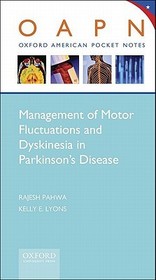
Management of Motor Fluctuations and Dyskinesia in Parkinson's Disease
Series: Oxford American Pocket Notes;
- Publisher's listprice GBP 9.99
-
4 510 Ft (4 295 Ft + 5% VAT)
The price is estimated because at the time of ordering we do not know what conversion rates will apply to HUF / product currency when the book arrives. In case HUF is weaker, the price increases slightly, in case HUF is stronger, the price goes lower slightly.
- Discount 10% (cc. 451 Ft off)
- Discounted price 4 059 Ft (3 866 Ft + 5% VAT)
Subcribe now and take benefit of a favourable price.
Subscribe
4 510 Ft

Availability
Out of print
Why don't you give exact delivery time?
Delivery time is estimated on our previous experiences. We give estimations only, because we order from outside Hungary, and the delivery time mainly depends on how quickly the publisher supplies the book. Faster or slower deliveries both happen, but we do our best to supply as quickly as possible.
Product details:
- Publisher Oxford University Press
- Date of Publication 13 October 2011
- ISBN 9780199841219
- Binding Spiral bound
- No. of pages48 pages
- Size 163x104x12 mm
- Weight 43 g
- Language English 0
Categories
Short description:
This pocket guide serves as an invaluable resource in aiding in the recognition and management of motor fluctuations and dyskinesia, and ultimately, improving the overall quality of life of persons with PD.
MoreLong description:
Levodopa-induced motor complications are extremely prevalent (affecting over half of all PD patients after 4-6 years of levodopa therapy), disabling, and one of the more challenging to treat of all PD symptoms. Motor fluctuations result in the re-appearance or a delay in relief of motor symptoms, following levodopa administration. Motor fluctuations occur more frequently as PD progresses and "on" periods (when motor symptoms are well-controlled) typically get shorter and "off"
periods (when motor symptoms re-emerge) get longer. Levodopa-related dyskinesia can also be disturbing and disabling. There are two major types of dyskinesia - "peak dose" and "diphasic" - which are manifested by variable sequences of parkinsonism, symptom improvement, and dyskinesia. Treatment
strategies for dyskinesia include adjustments in the timing and dose of levodopa, the use of amantadine (an agent with dopaminergic, NMDA receptor antagonist, norandrenergic and possibly anticholinergic activity) and deep brain stimulation surgery.
Part of the Oxford American Pocket Notes series, this volume is designed for general neurologists who are often the first physicians to receive complaints of motor fluctuations and dyskinesia in PD patients. This pocket guide serves as an invaluable resource in aiding in the recognition and management of motor fluctuations and dyskinesia, and ultimately, improving the overall quality of life of persons with PD.
Table of Contents:
Introduction
Epidemiology
Cost Issues
PD Treatments
Motor Complications
Assessments for Motor Complications
Strategies to Delay Motor Complications
Treatment of Motor Fluctuations
Treatment of Dyskinesia
Adjunctive Therapies: Dopaminergic Adverse Events
Deep Brain Stimulation (DBS)
Additional Therapy or Support
Internet Resources
References

