

- Publisher's listprice GBP 46.49
-
20 990 Ft (19 990 Ft + 5% VAT)
The price is estimated because at the time of ordering we do not know what conversion rates will apply to HUF / product currency when the book arrives. In case HUF is weaker, the price increases slightly, in case HUF is stronger, the price goes lower slightly.
- Discount 10% (cc. 2 099 Ft off)
- Discounted price 18 891 Ft (17 991 Ft + 5% VAT)
Subcribe now and take benefit of a favourable price.
Subscribe
20 990 Ft

Availability
printed on demand
Why don't you give exact delivery time?
Delivery time is estimated on our previous experiences. We give estimations only, because we order from outside Hungary, and the delivery time mainly depends on how quickly the publisher supplies the book. Faster or slower deliveries both happen, but we do our best to supply as quickly as possible.
Product details:
- Publisher OUP USA
- Date of Publication 17 May 2007
- ISBN 9780195309966
- Binding Hardback
- No. of pages312 pages
- Size 241x164x25 mm
- Weight 599 g
- Language English 0
Categories
Short description:
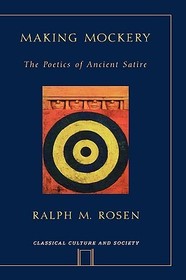
This book explores the dynamics of comic mockery and satire in Greek and Roman poetry, and argues that poets working with such material composed in accordance with shared generic principles and literary protocols. It encourages a synoptic, synchronic view of such poetry, from archaic iambus through Roman satire.
MoreLong description:
Making Mockery explores the dynamics of comic mockery and satire in Greek and Roman poetry, and argues that poets working with such material composed in accordance with shared generic principles and literary protocols. It encourages a synoptic, synchronic view of such poetry, from archaic iambus through Roman satire, and argues that if we can appreciate the abstract poetics of mockery that governs individual poets in such genres, we can we better understand how such poetry functioned in its own historical moment.
Rosen examines in particular the various strategies deployed by ancient satirical poets to enlist the sympathies of a putative audience, convince them of the justice of their indignation and the legitimacy of their personal attacks. The mocking satirist at the height of his power remains elusive and paradoxical-a figure of self-constructed abjection, yet arrogant and sarcastic at the same time; a figure whose speech can be self-righteous one moment, but scandalous the next; who will insist on the "reality" of his poetry, but make it clear that this reality is always mediated by an inescapable movement towards fictionality. While scholars have often, in principle, acknowledged the force of irony, persona-construction and other such devices by which satirists destabilize their claims, very often in practice-especially when considering individual satirists in isolation from others-they too succumb to the satirist's invitation to take what he says at face value. Despite the sophisticated critical tools they may bring to bear on satirical texts, therefore, classicists still tend to treat such poets ultimately as monochromatically indignant, vindictive individuals on a genuine self-righteous mission. This study, however, argues that that a far subtler analysis of the aggressive, poeticized subject in Classical antiquity-its target, and its audience-is called for.
Rosen offers his readers a richly detailed and subtle analysis of the 'genre' od satire with particular emphasis on the highly fraught relationship between poet and audience.

