

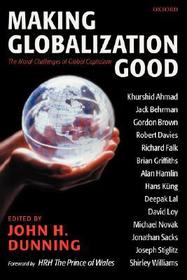
Making Globalization Good
The Moral Challenges of Global Capitalism
- Publisher's listprice GBP 47.99
-
21 667 Ft (20 635 Ft + 5% VAT)
The price is estimated because at the time of ordering we do not know what conversion rates will apply to HUF / product currency when the book arrives. In case HUF is weaker, the price increases slightly, in case HUF is stronger, the price goes lower slightly.
- Discount 10% (cc. 2 167 Ft off)
- Discounted price 19 500 Ft (18 572 Ft + 5% VAT)
Subcribe now and take benefit of a favourable price.
Subscribe
21 667 Ft

Availability
printed on demand
Why don't you give exact delivery time?
Delivery time is estimated on our previous experiences. We give estimations only, because we order from outside Hungary, and the delivery time mainly depends on how quickly the publisher supplies the book. Faster or slower deliveries both happen, but we do our best to supply as quickly as possible.
Product details:
- Publisher OUP Oxford
- Date of Publication 16 September 2004
- ISBN 9780199275229
- Binding Paperback
- No. of pages400 pages
- Size 234x156x23 mm
- Weight 607 g
- Language English
- Illustrations 2 figures 0
Categories
Short description:
How can we develop a global economic architecture which is efficient, morally acceptable, geographically inclusive, and sustainable over time? If global capitalism -- arguably the most efficient wealth-creating system known to man -- is to be both economically viable and socially acceptable, each of its four constituent institutions must be both technically competent and buttressed by a strong moral ethos. Leading thinkers in international business and ethics identify the pressing moral issues which global capitalism must answer.
MoreLong description:
Gordon Brown, Jonathan Sacks, Joseph Stiglitz, Hans Kung, Shirley Williams, and a dozen other leading thinkers in international business and ethics identify the pressing moral issues which global capitalism must answer.
How can we develop a global economic architecture which is efficient, morally acceptable, geographically inclusive, and sustainable over time?
If global capitalism -- arguably the most efficient wealth creating system currently known to man -- is to be both economically viable and socially acceptable, each of its four constituent institutions (markets, governments, supranational agencies, and civil society) must not only be technically competent, but also be buttressed and challenged by a strong moral ethos.
The book includes contributions from leading academics, politicians, and moralists. Recognizing that solutions will not come from any one quarter, and that any serious discussion of a just and equitable system will touch on questions of ethics and faith, the book approaches the issues from a range of different disciplines and forums.
This volume helps to advance our understanding of the ways in which the strucyire of globalizing capitalism, its content and effects may be strategically shaped to be, through consensus, better. This is an important, interesting and compelling book by a brilliant individual who has achieved much throughout his career.
Table of Contents:
Introduction
The Moral Imperatives of Global Capitalism: An overview
Private Morality and Capitalism: Learning from the past
Institutions and Morality: An economist's appraisal
Towards a New Paradigm of Development
Transformation of Society: Implications for globalization
Global Social Justice: The moral responsibilities of the rich to the poor
The Ethical Framework of the Global Market Economy
The Challenge of Global Capitalism: A Christian perspective
The Challenge of Global Capitalism: An Islamic perspective
Global Convenant: A Jewish perspective on globalization
The Challenge of Global Capitalism: The perspective of eastern religions
A Universal Culture of Human Rights and Freedom's Habits: Caritapolis
On the Political Relevance of Global Civil Society
[to be confirmed]
Governments and Supranational Agencies
Conclusion

