

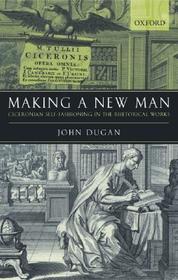
Making a New Man
Ciceronian Self-Fashioning in the Rhetorical Works
- Publisher's listprice GBP 222.50
-
100 458 Ft (95 675 Ft + 5% VAT)
The price is estimated because at the time of ordering we do not know what conversion rates will apply to HUF / product currency when the book arrives. In case HUF is weaker, the price increases slightly, in case HUF is stronger, the price goes lower slightly.
- Discount 10% (cc. 10 046 Ft off)
- Discounted price 90 413 Ft (86 108 Ft + 5% VAT)
Subcribe now and take benefit of a favourable price.
Subscribe
100 458 Ft

Availability
printed on demand
Why don't you give exact delivery time?
Delivery time is estimated on our previous experiences. We give estimations only, because we order from outside Hungary, and the delivery time mainly depends on how quickly the publisher supplies the book. Faster or slower deliveries both happen, but we do our best to supply as quickly as possible.
Product details:
- Publisher OUP Oxford
- Date of Publication 3 March 2005
- ISBN 9780199267804
- Binding Hardback
- No. of pages400 pages
- Size 223x146x26 mm
- Weight 597 g
- Language English 0
Categories
Short description:
Cicero (106-43 BCE) is known as Rome's greatest orator, which was precisely his plan. This book shows how Cicero used culturally ambitious works on the nature and history of oratory to fashion his identity as the supreme Roman public speaker and stylist. John Dugan reveals how Cicero uses his famous powers of persuasion to write himself into Roman cultural history and canonize his style as the supreme accomplishment of Roman prose literature.
MoreLong description:
In Making a New Man John Dugan investigates how Cicero (106-43 BCE) uses his major treatises on rhetorical theory (De oratore, Brutus, and Orator) in order to construct himself as a new entity within Roman cultural life: a leader who based his authority upon intellectual, oratorical, and literary accomplishments instead of the traditional avenues for prestige such as a distinguished familial pedigree or political or military feats. Eschewing conventional Roman notions of manliness, Cicero constructed a distinctly aesthetized identity that flirts with the questionable domains of the theatre and the feminine, and thus fashioned himself as a `new man'.
Were it up to me, John Dugan's Making a New Man would assume a central place in today's criticism of Roman rhetorical theory...[his approach is] an especially productive and provocative way of reading both rhetoric and rhetorical theory...[it is] a fertile synthesis of texts, themes, and modes of reading.
Table of Contents:
Introduction
1. Epideixis, Textuality, and Self-Fashioning in the Pro Archia and In Pisonem
2. Fashioning the Ideal Orator: Theatricality and Transgressive Aesthetics in the De oratore
`Writing' the Ideal Orator
Julius Caesar Strabo and Cicero's Self-Fashioning through Transgressive Aesthetics
Body and Style: Putting the Ideal Orator Together
3. The Brutus: Cicero's `Rhetorical' History
Caesarian Intertexts
History, Irony, and Autobiography in the Brutus
Varieties of Virtus: Brutus in the Brutus
4. The Orator: Fashioning a Ciceronian Sublime
The Orator's Intellectual, Personal, and Political Contexts
Style and the Self, Text and the Body
Making Your Mark: Written Ingenium in the Brutus and the Orator
Cicero and Demosthenes in `Longinus': The Ciceronian Sublime

