

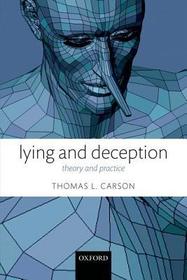
Lying and Deception
Theory and Practice
- Publisher's listprice GBP 39.99
-
18 055 Ft (17 195 Ft + 5% VAT)
The price is estimated because at the time of ordering we do not know what conversion rates will apply to HUF / product currency when the book arrives. In case HUF is weaker, the price increases slightly, in case HUF is stronger, the price goes lower slightly.
- Discount 10% (cc. 1 806 Ft off)
- Discounted price 16 249 Ft (15 476 Ft + 5% VAT)
Subcribe now and take benefit of a favourable price.
Subscribe
18 055 Ft

Availability
printed on demand
Why don't you give exact delivery time?
Delivery time is estimated on our previous experiences. We give estimations only, because we order from outside Hungary, and the delivery time mainly depends on how quickly the publisher supplies the book. Faster or slower deliveries both happen, but we do our best to supply as quickly as possible.
Product details:
- Publisher OUP Oxford
- Date of Publication 5 April 2012
- ISBN 9780199654802
- Binding Paperback
- No. of pages298 pages
- Size 234x157x16 mm
- Weight 440 g
- Language English 60
Categories
Short description:
This is the most comprehensive and up-to-date investigation of moral and conceptual questions about lying and deception. Carson argues that there is a moral presumption against lying and deception that causes harm, he examines case-studies from business, politics, and history, and he offers a qualified defence of the view that honesty is a virtue.
MoreLong description:
Thomas Carson offers the most comprehensive and up-to-date investigation of moral and conceptual questions about lying and deception. Part I addresses conceptual questions and offers definitions of lying, deception, and related concepts such as withholding information, "keeping someone in the dark," and "half truths." Part II deals with questions in ethical theory. Carson argues that standard debates about lying and deception between act-utilitarians and their critics are inconclusive because they rest on appeals to disputed moral intuitions. He defends a version of the golden rule and a theory of moral reasoning. His theory implies that there is a moral presumption against lying and deception that causes harm -- a presumption at least as strong as that endorsed by act-utilitarianism. He uses this theory to justify his claims about the issues he addresses in Part III: deception and withholding information in sales, deception in advertising, bluffing in negotiations, the duties of professionals to inform clients, lying and deception by leaders as a pretext for fighting wars, and lying and deception about history (with special attention to the Holocaust), and cases of distorting the historical record by telling half-truths. The book concludes with a qualified defence of the view that honesty is a virtue.
I think that Carson's analysis comes very close to capturing the normative element of lying ... Carson has produced an excellent work that combines conceptual analysis, moral theory, and applied philosophy. Anyone interested in lying and deception from any of these philosophical perspectives should read this book. Moreover, Carson is right to emphasize the conceptual and moral importance of warranting the truth of what you do not believe.
Table of Contents:
Introduction and Précis
PART I: CONCEPTS
Lying
Deception and Related Concepts
PART II: MORAL THEORY
PART II A: NORMATIVE ETHICAL THEORY
Kant and the Absolute Prohibition against Lying
Act-Utilitarianism
Ross and Rule-Consequentialism
PART II B: MORAL REASONING
The Golden Rule and a Theory of Moral Reasoning
PART II C: THE IMPLICATIONS OF IIA AND IIB FOR QUESTIONS ABOUT LYING AND DECEPTION
The Partial Overlap/Convergence of Reasonable Views
PART III: APPLICATIONS
Deception and Withholding Information on Sales
Deception in Advertising
Bluffing and Deception in Negotiations
Honesty, Professionals, and the Vulnerability of the Public
Lying and Deception about Questions of War and Peace: Case Studies
Honesty, Conflicts, and the Telling of History: More Case Studies
Honesty as a Virtue
Bibliography
Index

