

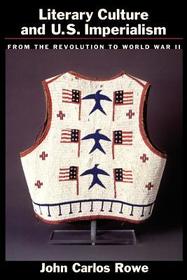
Literary Culture and US Imperialism
From the Revolution to World War II
- Publisher's listprice GBP 35.99
-
16 249 Ft (15 475 Ft + 5% VAT)
The price is estimated because at the time of ordering we do not know what conversion rates will apply to HUF / product currency when the book arrives. In case HUF is weaker, the price increases slightly, in case HUF is stronger, the price goes lower slightly.
- Discount 10% (cc. 1 625 Ft off)
- Discounted price 14 624 Ft (13 928 Ft + 5% VAT)
Subcribe now and take benefit of a favourable price.
Subscribe
16 249 Ft

Availability
printed on demand
Why don't you give exact delivery time?
Delivery time is estimated on our previous experiences. We give estimations only, because we order from outside Hungary, and the delivery time mainly depends on how quickly the publisher supplies the book. Faster or slower deliveries both happen, but we do our best to supply as quickly as possible.
Product details:
- Publisher OUP USA
- Date of Publication 20 July 2000
- ISBN 9780195131512
- Binding Paperback
- No. of pages400 pages
- Size 233x157x26 mm
- Weight 558 g
- Language English 0
Categories
Short description:
This book examines literary responses to U.S. imperialism from the late eighteenth century to the 1940s. Interpreting texts by Charles Brockden Brown, Poe, Melville, John Rollin Ridge, Twain, Henry Adams, Stephen Crane, W. E. B Du Bois, John Neihardt, Nick Black Elk, and Zora Neale Hurston, Rowe argues that U.S. literature has a long tradition of responding critically or contributing to our imperialist ventures.
MoreLong description:
John Carlos Rowe, considered one of the most eminent and progressive critics of American literature, has in recent years become instrumental in shaping the path of American studies. His latest book examines literary responses to U.S. imperialism from the late eighteenth century to the 1940s. Interpreting texts by Charles Brockden Brown, Poe, Melville, John Rollin Ridge, Twain, Henry Adams, Stephen Crane, W. E. B Du Bois, John Neihardt, Nick Black Elk, and Zora Neale Hurston, Rowe argues that U.S. literature has a long tradition of responding critically or contributing to our imperialist ventures. Following in the critical footsteps of Richard Slotkin and Edward Said, Literary Culture and U.S. Imperialism is particularly innovative in taking account of the public and cultural response to imperialism. In this sense it could not be more relevant to what is happening in the scholarship, and should be vital reading for scholars and students of American literature and culture.
Again and again a strength to Rowe's discussion emerges from his ability to contextualise literature productively ... The results are in virtually every case an important new reading of a classic text.

