

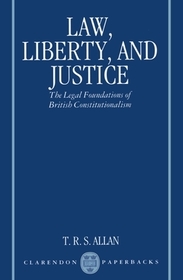
Law, Liberty, and Justice
The Legal Foundations of British Constitutionalism
Series: Clarendon Paperbacks;
- Publisher's listprice GBP 82.00
-
37 023 Ft (35 260 Ft + 5% VAT)
The price is estimated because at the time of ordering we do not know what conversion rates will apply to HUF / product currency when the book arrives. In case HUF is weaker, the price increases slightly, in case HUF is stronger, the price goes lower slightly.
- Discount 10% (cc. 3 702 Ft off)
- Discounted price 33 321 Ft (31 734 Ft + 5% VAT)
Subcribe now and take benefit of a favourable price.
Subscribe
37 023 Ft

Availability
printed on demand
Why don't you give exact delivery time?
Delivery time is estimated on our previous experiences. We give estimations only, because we order from outside Hungary, and the delivery time mainly depends on how quickly the publisher supplies the book. Faster or slower deliveries both happen, but we do our best to supply as quickly as possible.
Product details:
- Publisher Clarendon Press
- Date of Publication 15 December 1994
- ISBN 9780198259916
- Binding Paperback
- No. of pages316 pages
- Size 234x156x19 mm
- Weight 495 g
- Language English 0
Categories
Short description:
In a fresh appraisal of the fundamental doctrines of constitutional law, Allan examines the nature of the rule of law and the separation of powers. He refutes the traditional doctrine of unlimited parliamentary sovereignty, challenges the orthodox distinction between law and convention, and considers the character of common law rights and the nature and purpose of judicial review of administrative action.
MoreLong description:
The book makes a fresh appraisal of the main principles of constitutional law, seeking to stimulate renewed debate about the fundamentals of British constitutionalism. Rejecting a purely fromal concept of the rule of law, Allan argues that public law should more fully and openly reflect the principles of liberty and justice which constitute the underlying point and substance of the rule of law. The connection between law and justice is ultimately secured by the primary role of the individual conscience in making judgements about what the law requires. And just as no court is ever an infallible arbiter of legal obligation - the individual may sometimes have to stand by his own conscientious reading of the law - Parliament cannot be accorded unqualified authority to change the law. The sovreignty of Parliament is necessarily limited by residual principles of leberal constitutionalism; any other view would contradict the rule of law. Standard comparisons between written and unwritten constitutions, and traditional accounts of the separarion of powers, ovscure more than they reveal. The interpretation and application of statutes must always be a matter of judicial deliberation and judgement, just as the application of government policies and administrative orders is ultimately subject to the requirements of justice in particular cases.
Scholarly analysis of the fundamental legal doctrines of the British constitution ... highly contemporary in reflecting sophisticated recent restatements of liberal legal philosophy ... his efforts to tease out the implications for liberal constitutional thought of a wide range of public law doctrines deserves respect.

