

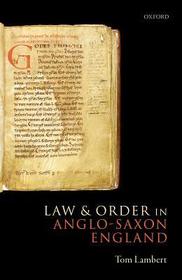
Law and Order in Anglo-Saxon England
- Publisher's listprice GBP 135.00
-
60 952 Ft (58 050 Ft + 5% VAT)
The price is estimated because at the time of ordering we do not know what conversion rates will apply to HUF / product currency when the book arrives. In case HUF is weaker, the price increases slightly, in case HUF is stronger, the price goes lower slightly.
- Discount 10% (cc. 6 095 Ft off)
- Discounted price 54 857 Ft (52 245 Ft + 5% VAT)
Subcribe now and take benefit of a favourable price.
Subscribe
60 952 Ft

Availability
printed on demand
Why don't you give exact delivery time?
Delivery time is estimated on our previous experiences. We give estimations only, because we order from outside Hungary, and the delivery time mainly depends on how quickly the publisher supplies the book. Faster or slower deliveries both happen, but we do our best to supply as quickly as possible.
Product details:
- Publisher OUP Oxford
- Date of Publication 16 February 2017
- ISBN 9780198786313
- Binding Hardback
- No. of pages416 pages
- Size 241x161x30 mm
- Weight 724 g
- Language English 0
Categories
Short description:
The only modern book-length account of Anglo-Saxon legal culture and practice, from the pre-Christian laws of Æthelberht of Kent (c. 600) up to the Norman conquest of 1066, charting the development of kings' involvement in law, in terms both of their authority to legislate and their ability to influence local practice.
MoreLong description:
Law and Order in Anglo-Saxon England explores English legal culture and practice across the Anglo-Saxon period, beginning with the essentially pre-Christian laws enshrined in writing by King Æthelberht of Kent in c. 600 and working forward to the Norman Conquest of 1066. It attempts to escape the traditional retrospective assumptions of legal history, focused on the late twelfth-century Common Law, and to establish a new interpretative framework for the subject, more sensitive to contemporary cultural assumptions and practical realities.
The focus of the volume is on the maintenance of order: what constituted good order; what forms of wrongdoing were threatening to it; what roles kings, lords, communities, and individuals were expected to play in maintaining it; and how that worked in practice. Its core argument is that the Anglo-Saxons had a coherent, stable, and enduring legal order that lacks modern analogies: it was neither state-like nor stateless, and needs to be understood on its own terms rather than as a variant or hybrid of these models. Tom Lambert elucidates a distinctively early medieval understanding of the tension between the interests of individuals and communities, and a vision of how that tension ought to be managed that, strikingly, treats strongly libertarian and communitarian features as complementary. Potentially violent, honour-focused feuding was an integral aspect of legitimate legal practice throughout the period, but so too was fearsome punishment for forms of wrongdoing judged socially threatening. Law and Order in Anglo-Saxon England charts the development of kings' involvement in law, in terms both of their authority to legislate and their ability to influence local practice, presenting a picture of increasingly ambitious and effective royal legal innovation that relied more on the cooperation of local communal assemblies than kings' sparse and patchy network of administrative officials.
This is an important book. Representing the most significant rethinking of Anglo-Saxon law and order ... its arguments will be rehearsed and revisited for years to come ... This is a truly superb first monograph, which will not only change the way we approach Anglo-Saxon law and order, but how we think about legislation and society in the early medieval West more generally. I cannot recommend it strongly enough.
Table of Contents:
Introduction: Approaching Law and Order in the Early Middle Ages
PART I: THE FOUNDATIONS OF THE ANGLO-SAXON LEGAL ORDER
Law before Æthelberht
Kingship, Legislation, and Punishment in the Seventh Century
Royal Administration and Legal Practice to the Early Tenth Century
PART II: ORDER AND "THE STATE" IN LATE ANGLO-SAXON ENGLAND
Substantive Legal Change
Ideals of Kingship and Order
Local Legal Practice and Royal Control
Rights and Revenues
Conclusion: Continuity, Change, and the Norman Conquest
Bibliography

