

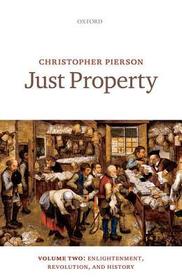
Just Property
Volume Two: Enlightenment, Revolution, and History
- Publisher's listprice GBP 99.00
-
44 698 Ft (42 570 Ft + 5% VAT)
The price is estimated because at the time of ordering we do not know what conversion rates will apply to HUF / product currency when the book arrives. In case HUF is weaker, the price increases slightly, in case HUF is stronger, the price goes lower slightly.
- Discount 10% (cc. 4 470 Ft off)
- Discounted price 40 229 Ft (38 313 Ft + 5% VAT)
Subcribe now and take benefit of a favourable price.
Subscribe
44 698 Ft

Availability
printed on demand
Why don't you give exact delivery time?
Delivery time is estimated on our previous experiences. We give estimations only, because we order from outside Hungary, and the delivery time mainly depends on how quickly the publisher supplies the book. Faster or slower deliveries both happen, but we do our best to supply as quickly as possible.
Product details:
- Publisher OUP Oxford
- Date of Publication 22 September 2016
- ISBN 9780199673292
- Binding Hardback
- No. of pages260 pages
- Size 240x164x20 mm
- Weight 528 g
- Language English 0
Categories
Short description:
This volume traces the development of ideas about property in the Western world from the early eighteenth century, through the Enlightenment and the experience of the French Revolution to the critical stance of socialists and anarchists in the nineteenth century.
MoreLong description:
Property remains the bedrock of the societies we all inhabit. It underpins our core institutions - including families, states and economies - and it is the medium through which the intensifying politics of inequality is played out. There is plenty of evidence that its importance is increasing in a world of growing wealth inequality and depletion of natural resources.
Volume Two of Just Property traces the development of ideas about property in the Western world from the early eighteenth century, through the Enlightenment and the experience of the French Revolution, to the critical stance of socialists and anarchists in the nineteenth century. It ranges across the thought of Bernard Mandeville, David Hume, Adam Smith, Voltaire, Rousseau, Kant, Hegel, the Abbe de Sieyes, Burke, Wollstonecraft, Charles Fourier, Karl Marx, Proudhon and Peter Kropotkin. Many themes persist from an earlier period, as does the influence of Christianity and the Roman Law but there are also many innovations. In general, the authority of God and the natural law recedes and the themes of utility and securing general welfare became more prominent. In the wake of Locke, labour, though sometimes in the form of 'past labour', that is capital, attains a new prominence. For its admirers, a newly-unfettered private property is the means of securing personal freedom, constraining authoritarian governments, promoting the arts and sciences, and delivering an unprecedented improvement in the material condition of the whole population. For its critics, private property is the central component in a new political economy of systemic and unlimited class exploitation. It penetrates everywhere and corrupts everything that it touches.
With these arguments, we are clearly on the terrain of modernity, witnessing a set of arguments and counter-arguments with which we all still struggle.
Just Property amply illustrates, by historical example, why property should be at the core of political theory. The strength of Just Property is in how it combines rigorous scholarship with witty commentary that quietly celebrates Rousseau's 'heroic failure' and sighs at the German Idealists' knack for starting in all the wrong places.
Table of Contents:
Introduction
The Scottish Enlightenment
The French Enlightenment
The German Enlightenment - and beyond
The French Revolution - and its aftermath
Socialism
Anarchism

