

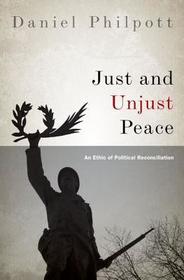
Just and Unjust Peace
An Ethic of Political Reconciliation
Series: Studies in Strategic Peacebuilding;
- Publisher's listprice GBP 45.49
-
20 538 Ft (19 560 Ft + 5% VAT)
The price is estimated because at the time of ordering we do not know what conversion rates will apply to HUF / product currency when the book arrives. In case HUF is weaker, the price increases slightly, in case HUF is stronger, the price goes lower slightly.
- Discount 10% (cc. 2 054 Ft off)
- Discounted price 18 484 Ft (17 604 Ft + 5% VAT)
Subcribe now and take benefit of a favourable price.
Subscribe
20 538 Ft

Availability
printed on demand
Why don't you give exact delivery time?
Delivery time is estimated on our previous experiences. We give estimations only, because we order from outside Hungary, and the delivery time mainly depends on how quickly the publisher supplies the book. Faster or slower deliveries both happen, but we do our best to supply as quickly as possible.
Product details:
- Publisher OUP USA
- Date of Publication 11 October 2012
- ISBN 9780199827565
- Binding Hardback
- No. of pages368 pages
- Size 236x152x33 mm
- Weight 590 g
- Language English 0
Categories
Short description:
In the wake of political evil on a large scale, what does justice consist of? Daniel Philpott takes up this question in Just and Unjust Peace. While scholars have written about many aspects of dealing with past injustice, no general ethic has emerged. Philpott seeks to provide a holistic model that delivers concrete ethical guidelines for societies striving to build peace.
MoreLong description:
In the wake of massive injustice, how can justice be achieved and peace restored? Is it possible to find a universal standard that will work for people of diverse and often conflicting religious, cultural, and philosophical backgrounds?
In Just and Unjust Peace, Daniel Philpott offers an innovative and hopeful response to these questions. He challenges the approach to peace-building that dominates the United Nations, western governments, and the human rights community. While he shares their commitments to human rights and democracy, Philpott argues that these values alone cannot redress the wounds caused by war, genocide, and dictatorship. Both justice and the effective restoration of political order call for a more holistic, restorative approach. Philpott answers that call by proposing a form of political reconciliation that is deeply rooted in three religious traditions--Christianity, Islam, and Judaism--as well as the restorative justice movement. These traditions offer the fullest expressions of the core concepts of justice, mercy, and peace. By adapting these ancient concepts to modern constitutional democracy and international norms, Philpott crafts an ethic that has widespread appeal and offers real hope for the restoration of justice in fractured communities. From the roots of these traditions, Philpott develops six practices--building just institutions and relations between states, acknowledgment, reparations, restorative punishment, apology and, most important, forgiveness--which he then applies to real cases, identifying how each practice redresses a unique set of wounds.
Focusing on places as varied as Bosnia, Iraq, South Africa, Germany, Sierra Leone, Timor-Leste, Chile and many others--and drawing upon the actual experience of victims and perpetrators--Just and Unjust Peace offers a fresh approach to the age-old problem of restoring justice in the aftermath of widespread injustice.
The book draws on religious traditions to construct a framework that it claims could be applied to ethnoreligious conflicts. The strength of the book, therefore, is its attempt to bridge the divide between the religious and the secular, with Philpott challenging perceptions that deep fissures exist between different religious practices by illustrating their congruence. This attempt to reconcile different religious values has inherent value as it expands the discourse on using alternative methods in transitional justice.
Table of Contents:
Introduction
Part One: Reconciliation as a Concept of Justice
Chapter One: Whose Justice?
Chapter Two: The Basic Standards of Justice
Chapter Three: The Wounds of Political Injustice
Chapter Four: Reconciliation as a Concept of Justice
Chapter Five: Is Reconciliation Fit for Politics?
Part Two: Religion and Reconciliation
Chapter Six: Is Religion Fit For Reconciliation?
Chapter Seven: Reconciliation in the Jewish Tradition
Chapter Eight: Reconciliation in the Christian Tradition
Chapter Nine: Reconciliation in the Islamic Tradition
Part Three: Practicing Political Reconciliation
Chapter Ten: Four Practices: Building Institutions for Social Justice, Acknowledgment, Reparations, and Apology
Chapter Eleven: Punishment
Chapter Twelve: Forgiveness
Conclusion

