

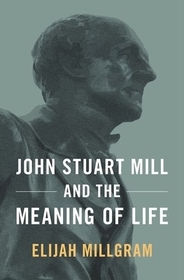
John Stuart Mill and the Meaning of Life
- Publisher's listprice GBP 81.00
-
38 697 Ft (36 855 Ft + 5% VAT)
The price is estimated because at the time of ordering we do not know what conversion rates will apply to HUF / product currency when the book arrives. In case HUF is weaker, the price increases slightly, in case HUF is stronger, the price goes lower slightly.
- Discount 10% (cc. 3 870 Ft off)
- Discounted price 34 828 Ft (33 170 Ft + 5% VAT)
Subcribe now and take benefit of a favourable price.
Subscribe
38 697 Ft

Availability
printed on demand
Why don't you give exact delivery time?
Delivery time is estimated on our previous experiences. We give estimations only, because we order from outside Hungary, and the delivery time mainly depends on how quickly the publisher supplies the book. Faster or slower deliveries both happen, but we do our best to supply as quickly as possible.
Product details:
- Publisher OUP USA
- Date of Publication 5 September 2019
- ISBN 9780190873240
- Binding Hardback
- No. of pages256 pages
- Size 160x239x22 mm
- Weight 454 g
- Language English 0
Categories
Short description:
This book is simultaneously an exercise in biography-one with a tragic narrative, to boot-and a novel reconstruction and reframing of some of the central theories and texts of our canon. And it attempts to look at the theory of rationality from an unusual angle, by asking this question: what difference does it make to the shape and progress of someone's life whether he has one or another understanding of practical reasoning-that is, of how one ought to reason about what to do?
MoreLong description:
John Stuart Mill was one of the most important and influential philosophers of the nineteenth century. He was also someone who exemplified a view about the meaning of life that is widespread among both philosophers and nonacademics: that projects are what make your life meaningful, and if a single project is large enough to occupy center stage in it, that is the meaning of your life. His brilliant career notwithstanding, Mill's life was a train wreck; the intellectual energy and philosophical ingenuity which he devoted to figuring out what had gone wrong make him a fascinating object lesson in the view that projects give life meaning. Elijah Millgram argues that what went wrong was the very fact that Mill's life was a project-the tragedy of his life was an almost inevitable consequence of living out this account of the meaning of life.
At once a scholarly contribution to the history of an important philosophical figure and an intervention in an ongoing debate within moral philosophy, this book takes on a topic that people outside the academy expect philosophy to address, but which it too rarely does: namely, the meaning of life. It is simultaneously an exercise in biography and a novel reconstruction and reframing of some of the central theories and texts of the philosophical canon. Millgram's work attempts to look at the theory of rationality from an unusual angle by asking: what difference does it make to the shape and progress of someone's life whether he has one or another understanding of practical reasoning-that is, of how one ought to reason about what to do?
It is clear that the challenge of a dual purpose book is brilliantly taken up by Millgram. The conclusion he gives in chapter twelve concerning the intrinsic inconsistency of a project life is effectively supported by the detailed review of Mill's life. From a biographical point of view, Millgram went a long way by producing numerous hypotheses concerning the articulation between thought and life of the author, often allowing himself to go against Mill's own account. These audacious hypotheses are the great richness of this book.
Table of Contents:
1 Introduction
2 From Principle to Project
3 Mill's Epiphany
4 Mill's Postdoc
5 How to Write a Letter of Recommendation
6 Logic and the Problem of Necessity
7 Mill's Incubus
8 Justice, Freedom of Speech and Other Higher Pleasures
9 Taking Liberties with Utilitarianism
10 Mill's Aftermath
11 A Very Quiet Traged
12 Concluding Remarks
A Mill's Metaphysical Paradox
Bibliography

