

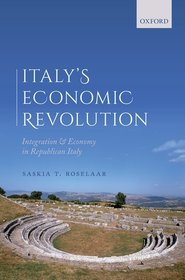
Italy's Economic Revolution
Integration and Economy in Republican Italy
- Publisher's listprice GBP 105.00
-
47 407 Ft (45 150 Ft + 5% VAT)
The price is estimated because at the time of ordering we do not know what conversion rates will apply to HUF / product currency when the book arrives. In case HUF is weaker, the price increases slightly, in case HUF is stronger, the price goes lower slightly.
- Discount 10% (cc. 4 741 Ft off)
- Discounted price 42 667 Ft (40 635 Ft + 5% VAT)
Subcribe now and take benefit of a favourable price.
Subscribe
47 407 Ft

Availability
printed on demand
Why don't you give exact delivery time?
Delivery time is estimated on our previous experiences. We give estimations only, because we order from outside Hungary, and the delivery time mainly depends on how quickly the publisher supplies the book. Faster or slower deliveries both happen, but we do our best to supply as quickly as possible.
Product details:
- Publisher OUP Oxford
- Date of Publication 25 September 2019
- ISBN 9780198829447
- Binding Hardback
- No. of pages314 pages
- Size 241x163x23 mm
- Weight 636 g
- Language English
- Illustrations 8 black-and-white figures and 2 maps 0
Categories
Short description:
The Roman conquest of Italy in the Republican period led to widespread economic changes in which the conquered Italians played an important role. This volume explores the interplay between economic activities and the integration of the Italian peoples into the Roman civic, legal, social, and cultural framework.
MoreLong description:
The Roman conquest of Italy in the Republican period (from c. 400 to 50 BC) led to widespread economic changes in which the conquered Italians played an important role. Italy's Economic Revolution analyses the integration of Italy during this period and explores the interplay between economic activities and unification in its civic, legal, social, and cultural senses. On one hand, it investigates whether Italy became more integrated economically following the Roman conquest and traces the widely varying local reactions to the globalization of the Italian economy; on the other, it examines whether and how economic activities carried out by Italians contributed to the integration of the Italian peoples into the Roman framework.
Throughout the Republican period, Italians were able to profit from the expansion of the Roman dominion in the Mediterranean and the new economic opportunities it afforded, which led to gradual changes in institutions, culture, and language: through overseas trade and commercial agriculture they had gained significant wealth, which they invested in the Italian landscape, and they were often ahead of Romans when it came to engagement with Hellenistic culture. However, their economic prosperity and cultural sophistication did not lead to civic equality, nor to equal opportunities to exploit the territories the Italians had conquered under Rome's lead. Eventually the Italians rose in rebellion against Rome in the Social War of 91-88 BC, after which they were finally granted Roman citizenship. This volume investigates not only whether and how economic interaction played a role in this civic integration, but also highlights the importance of Roman citizenship as an instrument of further economic, political, social, and cultural integration between Romans and Italians.
...stimulating book.
Table of Contents:
Frontmatter
List of Figures
List of Maps
Introduction: economy and integration in the Roman Republic
Introduction
The structure of this book
Economic activities and institutions
Integration and identity
Integration and Romanization
The administration of conquered areas
Sources and methodology
Points of contact: interaction between Roman and Italian
Introduction
Roman colonization and spatial integration between Romans and Italians
Migration and mobility
Sanctuaries and temples as meeting places
Fairs and markets
Other interactions between Romans and Italians
Military service
Social relations: intermarriage, friendships, elite networks
Conclusion
The economic integration of Italy
Introduction
Italian commercial activities in the Mediterranean
Italians in the Mediterranean
Commercial export
Developments in agriculture and manufacturing
Economic developments in Italy
Latium
Campania
Apulia
Lucania and Bruttium
Macroeconomic developments in Republican Italy
Conclusion
Consequences of interaction: institutional and cultural change
Introduction
Legal and institutional instruments for interaction
Legal developments
Italian administration and institutions
Italian and Roman coinage
Weights and measures
Conclusion
The investment of wealth in Italy
Cultural developments
Linguistic developments
The concept of Italian and Italian identity
Roman protection of its allies
Conclusion
From economic to political integration
Introduction
Cultural prejudice against Italians
The position of Italians in the late second century
Roman and Italian power relations
Lack of Roman citizenship and its negative effects for economic activities
Other causes of resentment
Demands for citizenship in the late second century
The outbreak of the Social War
The grant of citizenship to the Italians
Political and economic opportunities for Italians after the Social War
Italian identity after the Social War
Conclusion
General conclusions
Endmatter
Bibliography
Index

