

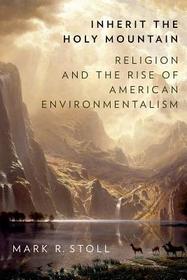
Inherit the Holy Mountain
Religion and the Rise of American Environmentalism
- Publisher's listprice GBP 36.99
-
16 700 Ft (15 905 Ft + 5% VAT)
The price is estimated because at the time of ordering we do not know what conversion rates will apply to HUF / product currency when the book arrives. In case HUF is weaker, the price increases slightly, in case HUF is stronger, the price goes lower slightly.
- Discount % (cc. 0 Ft off)
- Discounted price 0 Ft (0 Ft + 5% VAT)
Subcribe now and take benefit of a favourable price.
Subscribe
16 700 Ft

Availability
printed on demand
Why don't you give exact delivery time?
Delivery time is estimated on our previous experiences. We give estimations only, because we order from outside Hungary, and the delivery time mainly depends on how quickly the publisher supplies the book. Faster or slower deliveries both happen, but we do our best to supply as quickly as possible.
Product details:
- Publisher OUP USA
- Date of Publication 12 October 2017
- ISBN 9780190697945
- Binding Paperback
- No. of pages440 pages
- Size 231x155x27 mm
- Weight 635 g
- Language English
- Illustrations 26 color, 11 b/w illus. 0
Categories
Short description:
Inherit the Holy Mountain puts religion at the center of the history of American environmentalism rather than at its margins, demonstrating how religion provided environmentalists with content, direction, and tone for the environmental causes they espoused.
MoreLong description:
In Inherit the Holy Mountain, historian Mark Stoll introduces us to the religious roots of the American environmental movement. Religion, he shows, provided environmentalists both with deeply-embedded moral and cultural ways of viewing the world and with content, direction, and tone for the causes they espoused.
Stoll discovers that specific denominational origins corresponded with characteristic sets of ideas about nature and the environment as well as distinctive aesthetic reactions to nature, as can be seen in key works of art analyzed throughout the book.
Stoll also provides insight into the possible future of environmentalism in the United States, concluding with an examination of the current religious scene and what it portends for the future. By debunking the supposed divide between religion and American environmentalism, Inherit the Holy Mountain opens up a fundamentally new narrative in environmental studies.
If the geographic region of focus is the United States, then the book is mandatory. The impressive amount of data covered in its pages, and the cohesive narrative that contextualizes and analyzes this data, cannot be captured in a 1,600-word book review. Scholars owe Stoll a debt of gratitude for the 30 years of dedication to crafting this thorough treatment of the impact religion has had on environmentalism in the US. This gratitude should begin with the assignment of this book in graduate seminars devoted to interactions between religion and nature, where it can provide a shining example of scholarship toward which future leaders of the field should aspire.
Table of Contents:
Introduction
1. Calvinism and Nature: American Foundations
2. Origins of Conservation in the Puritan Landscape
3. Building the Moral Society: Farms, Forests, and Parks
4. Nature, Parks, and Emersonian Modernism
5. Progressive Presbyterian Conservation
6. Presbyterians and the Environmental Movement
7. Nature and New England's Outsiders
8. A New Era
Conclusion
Appendix
Notes
Index

