

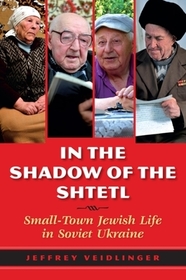
In the Shadow of the Shtetl
Small-Town Jewish Life in Soviet Ukraine
- Publisher's listprice GBP 26.99
-
12 894 Ft (12 280 Ft + 5% VAT)
The price is estimated because at the time of ordering we do not know what conversion rates will apply to HUF / product currency when the book arrives. In case HUF is weaker, the price increases slightly, in case HUF is stronger, the price goes lower slightly.
- Discount 10% (cc. 1 289 Ft off)
- Discounted price 11 605 Ft (11 052 Ft + 5% VAT)
Subcribe now and take benefit of a favourable price.
Subscribe
12 894 Ft

Availability
Uncertain availability. Please turn to our customer service.
Why don't you give exact delivery time?
Delivery time is estimated on our previous experiences. We give estimations only, because we order from outside Hungary, and the delivery time mainly depends on how quickly the publisher supplies the book. Faster or slower deliveries both happen, but we do our best to supply as quickly as possible.
Product details:
- Publisher Indiana University Press
- Date of Publication 1 November 2013
- Number of Volumes Print PDF
- ISBN 9780253011510
- Binding Hardback
- No. of pages424 pages
- Size 229x152 mm
- Weight 748 g
- Language English
- Illustrations 21 color illus., 15 b&w illus., 4 maps 0
Categories
Long description:
The story of how the Holocaust decimated Jewish life in the shtetls of Eastern Europe is well known. Still, thousands of Jews in these small towns survived the war and returned afterward to rebuild their communities. The recollections of some 400 returnees in Ukraine provide the basis for Jeffrey Veidlinger’s reappraisal of the traditional narrative of 20th-century Jewish history. These elderly Yiddish speakers relate their memories of Jewish life in the prewar shtetl, their stories of survival during the Holocaust, and their experiences living as Jews under Communism. Despite Stalinist repressions, the Holocaust, and official antisemitism, their individual remembrances of family life, religious observance, education, and work testify to the survival of Jewish life in the shadow of the shtetl to this day.
Hitherto the story of the Holocaust in the Eastern European shtetl has been told by those who left—on behalf of those who did not survive. What do we learn from these stories told from the shtetl itself? In the Shadow of the Shtetl restores horror to the setting in which it occurred: at home, among familiar people and places. . . . In their accounts the everyday and the extraordinary, the innocuous and the gruesome are continually intertwined. The same people participated in both. The relationship between the normal and the abnormal, the intimate and the alien takes on a different shape in these stories—perhaps a shape that can help us better understand places like Rwanda or Cambodia—or Bosnia. More

