

- Publisher's listprice GBP 93.00
-
44 430 Ft (42 315 Ft + 5% VAT)
The price is estimated because at the time of ordering we do not know what conversion rates will apply to HUF / product currency when the book arrives. In case HUF is weaker, the price increases slightly, in case HUF is stronger, the price goes lower slightly.
- Discount 10% (cc. 4 443 Ft off)
- Discounted price 39 988 Ft (38 084 Ft + 5% VAT)
Subcribe now and take benefit of a favourable price.
Subscribe
44 430 Ft

Availability
printed on demand
Why don't you give exact delivery time?
Delivery time is estimated on our previous experiences. We give estimations only, because we order from outside Hungary, and the delivery time mainly depends on how quickly the publisher supplies the book. Faster or slower deliveries both happen, but we do our best to supply as quickly as possible.
Product details:
- Publisher OUP USA
- Date of Publication 4 June 2009
- ISBN 9780195374964
- Binding Hardback
- No. of pages504 pages
- Size 160x236x35 mm
- Weight 825 g
- Language English 0
Categories
Short description:
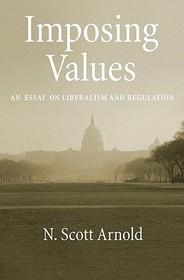
Imposing Values provides an even-handed characterization of the differences between modern liberalism and classical liberalism about the proper scope of government. It also systematically and comprehensively discusses arguments for and against various regulatory regimes favored by modern liberals and opposed by classical liberals.
MoreLong description:
A major question for liberal politics and liberal political theory concerns the proper scope of government. Liberalism has always favored limited government, but there has been wide-ranging dispute among liberals about just how extensive the scope of government should be. Included in this dispute are questions about the extent of state ownership of the means of production, redistribution of wealth and income through the tax code and transfer programs, and the extent of government regulation.
One of N. Scott Arnold's goals is to give an accurate characterization of both modern liberalism and classical liberalism, explaining along the way why libertarianism is not the only form that classical liberalism can take. The main focus of Arnold's book, however, concerns regulation--specifically, the modern liberal regulatory agenda as it has taken shape in contemporary American society. This is the set of regulatory regimes favored by all modern liberals and opposed by all classical liberals. It includes contemporary employment law in all its manifestations, health and safety regulation, and land use regulation. The heart of the book consists of a systematic evaluation of arguments for and against all the items on this agenda. It turns out that there are good arguments on both sides for most of these regulatory regimes. Because of this, and because someone's vision of the proper scope of government will ultimately prevail, some procedural requirements that all liberals could agree to must be satisfied for one side to impose legitimately its values on the polity at large. These procedural requirements are identified, argued for, and then applied to the elements of the modern liberal regulatory agenda. Arnold argues that many, though not all, of these elements have been illegitimately imposed on American society.
Table of Contents:
Rights, Externalities, and Public Goods
Private and Public Property
the Nature of Private Property Rights
The Modern Liberal Regulatory Agenda
Common Ground Arguments
Regulatory Public Goods
Conversion Arguments: Employment Law
Conversion Arguments: Anti-Discrimination Law
Conversion Arguments: Health & Safety Regulation
Conversion Arguments: Land Use Regulation
Imposing Values
Applications

