

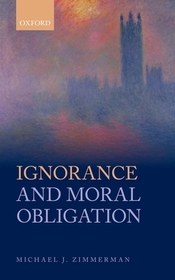
Ignorance and Moral Obligation
- Publisher's listprice GBP 68.00
-
30 702 Ft (29 240 Ft + 5% VAT)
The price is estimated because at the time of ordering we do not know what conversion rates will apply to HUF / product currency when the book arrives. In case HUF is weaker, the price increases slightly, in case HUF is stronger, the price goes lower slightly.
- Discount 10% (cc. 3 070 Ft off)
- Discounted price 27 632 Ft (26 316 Ft + 5% VAT)
Subcribe now and take benefit of a favourable price.
Subscribe
30 702 Ft

Availability
printed on demand
Why don't you give exact delivery time?
Delivery time is estimated on our previous experiences. We give estimations only, because we order from outside Hungary, and the delivery time mainly depends on how quickly the publisher supplies the book. Faster or slower deliveries both happen, but we do our best to supply as quickly as possible.
Product details:
- Publisher OUP Oxford
- Date of Publication 27 March 2014
- ISBN 9780199688852
- Binding Hardback
- No. of pages160 pages
- Size 223x154x18 mm
- Weight 322 g
- Language English 0
Categories
Short description:
Michael J. Zimmerman explores whether and how our ignorance about ourselves and our circumstances affects what our moral obligations and moral rights are. He rejects objective and subjective views of the nature of moral obligation, and presents a new case for a 'prospective' view.
MoreLong description:
Ignorance and Moral Obligation concerns whether and how our ignorance about ourselves and our circumstances affects what our moral obligations and moral rights are. Michael J. Zimmerman begins by distinguishing three well-established views about the nature of moral obligation: the Objective, Subjective, and Prospective Views. Some philosophers have attempted to reconcile the three views in question, but these attempts are shown to fail. The question thus arises: which of the three views ought to be accepted and which rejected? Zimmerman argues that, in light of the ignorance that besets us, the Objective and Subjective Views should be rejected and the Prospective View accepted. The argument is based on close consideration of a kind of case provided by Frank Jackson, one in which an agent has deficient evidence regarding the outcomes of his options. Many objections to this argument are entertained and rebutted, by means of which the Prospective View is itself elaborated and defended. Among those who accept the Prospective View, the primary motivation for doing so has often been that of finding a useful guide to action, but Zimmerman argues that the Prospective View can be only of strictly limited help in providing such a guide. Finally, he addresses some implications that the Prospective View has regarding the nature of moral rights. Our possession of moral rights is precarious, being dependent on the evidence possessed by others. Once again, several objections are entertained and rebutted. The distinction between rights and desert is stressed, and the relevance of risk to rights is explored.
To conclude, those interested in the nature of moral obligation should certainly read Zimmerman's book. It is well written and insightful.
Table of Contents:
Preface
Acknowledgments
Three Views of Moral Obligation
In Defense of the Prospective View
In Further Defense of the Prospective View
Action-guidance
Moral Rights
Bibliography
Index

