

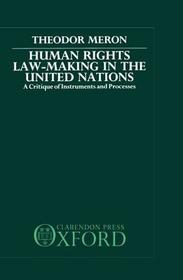
Human Rights Law-Making in the United Nations
A Critique of Instruments and Process
- Publisher's listprice GBP 135.00
-
60 952 Ft (58 050 Ft + 5% VAT)
The price is estimated because at the time of ordering we do not know what conversion rates will apply to HUF / product currency when the book arrives. In case HUF is weaker, the price increases slightly, in case HUF is stronger, the price goes lower slightly.
- Discount 10% (cc. 6 095 Ft off)
- Discounted price 54 857 Ft (52 245 Ft + 5% VAT)
Subcribe now and take benefit of a favourable price.
Subscribe
60 952 Ft

Availability
printed on demand
Why don't you give exact delivery time?
Delivery time is estimated on our previous experiences. We give estimations only, because we order from outside Hungary, and the delivery time mainly depends on how quickly the publisher supplies the book. Faster or slower deliveries both happen, but we do our best to supply as quickly as possible.
Product details:
- Publisher OUP Oxford
- Date of Publication 11 December 1986
- ISBN 9780198255499
- Binding Hardback
- No. of pages368 pages
- Size 222x145x28 mm
- Weight 548 g
- Language English 0
Categories
Short description:
This book is an examination and critique of the methods employed by the United Nations in adopting human rights instruments. The author concludes that the present system of law-making is inadequate and points to many examples of unclear provisions and of overlap and conflict within a single instrument or between instruments.
MoreLong description:
This book is an examination and critique of the methods employed by the United Nations in adopting human rights instruments. Three of the major instruments - the International Convention on the Elimination of All Forms of Racial Discrimination, the Convention on the Elimination of All Forms of Discrimination Against Women, and the International Convention on Civil and Political Rights - are selected for detailed study. The author concludes that the present system of law-making is inadequate and points to many examples of unclear provisions and of overlap and conflict within a single instrument or between instruments. In order that this important function of the organized international community, that of protecting human rights, can work effectively, improvements in law-making techniques are necessary, and Professor Meron concludes with some suggestions for reforms both of the institutions and of the process itself.
More
