

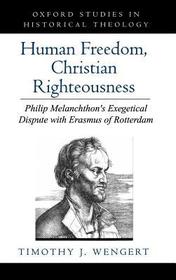
Human Freedom, Christian Righteousness
Philip Melanchthon's Exegetical Dispute with Erasmus of Rotterdam
Series: Oxford Studies in Historical Theology;
- Publisher's listprice GBP 162.50
-
73 368 Ft (69 875 Ft + 5% VAT)
The price is estimated because at the time of ordering we do not know what conversion rates will apply to HUF / product currency when the book arrives. In case HUF is weaker, the price increases slightly, in case HUF is stronger, the price goes lower slightly.
- Discount 10% (cc. 7 336 Ft off)
- Discounted price 66 032 Ft (62 888 Ft + 5% VAT)
Subcribe now and take benefit of a favourable price.
Subscribe
73 368 Ft

Availability
printed on demand
Why don't you give exact delivery time?
Delivery time is estimated on our previous experiences. We give estimations only, because we order from outside Hungary, and the delivery time mainly depends on how quickly the publisher supplies the book. Faster or slower deliveries both happen, but we do our best to supply as quickly as possible.
Product details:
- Publisher OUP USA
- Date of Publication 30 April 1998
- ISBN 9780195115291
- Binding Hardback
- No. of pages256 pages
- Size 235x162x21 mm
- Weight 544 g
- Language English 0
Categories
Short description:
In the 1520s a battle raged between Luther and Erasmus over the freedom of the will. This book demonstrates that Philip Melanchthon - hardly a silent observer in the fray - was actively involved, especially in his 1528 commentary on Colossians. He rejected Erasmus's position while developing an independent, but compatible stance to Luther's own. Though seemingly focused on a narrow exegetical dispute, the book deals with a variety of large and important questions - the complicated and elusive relationships between humanism and the Reformation, Erasmus and Luther, Erasmus and Melanchthon, and Melanchthon and Luther; and all the issues of proper biblical interpretation of free will, of divine and human righteousness, and of political order.
MoreLong description:
This book argues that Philip Melanchthon, conventionally pictured as hopelessly caught in the middle between Erasmus and Luther, and more "Erasmian" than a Lutheran theologian should have been, was, at least theologically, not Erasmian at all, but in fact sharply anti-Erasmus. Wengert draws largely on Melanchthon's Scholia on the Epistle of Paul to the Colossians as well as on a range of other contemporary sources to address a number of important questions, including the complicated and elusive relationship between humanism and the Reformation and the issues of proper biblical interpretation of free will, of divine and human righteousness, and of political order.
Wengert's book clearly ranks with the very best studies of Melanchthon that we have in print.

