

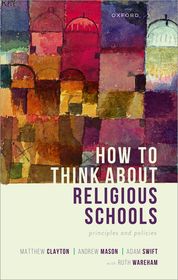
How to Think about Religious Schools
Principles and Policies
- Publisher's listprice GBP 70.00
-
31 605 Ft (30 100 Ft + 5% VAT)
The price is estimated because at the time of ordering we do not know what conversion rates will apply to HUF / product currency when the book arrives. In case HUF is weaker, the price increases slightly, in case HUF is stronger, the price goes lower slightly.
- Discount 20% (cc. 6 321 Ft off)
- Discounted price 25 284 Ft (24 080 Ft + 5% VAT)
- Discount is valid until: 30 June 2026
Subcribe now and take benefit of a favourable price.
Subscribe
31 605 Ft

Availability
Estimated delivery time: In stock at the publisher, but not at Prospero's office. Delivery time approx. 3-5 weeks.
Not in stock at Prospero.
Why don't you give exact delivery time?
Delivery time is estimated on our previous experiences. We give estimations only, because we order from outside Hungary, and the delivery time mainly depends on how quickly the publisher supplies the book. Faster or slower deliveries both happen, but we do our best to supply as quickly as possible.
Product details:
- Publisher OUP Oxford
- Date of Publication 15 August 2024
- ISBN 9780198924005
- Binding Hardback
- No. of pages224 pages
- Size 223x44x17 mm
- Weight 408 g
- Language English 529
Categories
Short description:
A clear and accessible account of what is at stake in debates about religious schools. The volume provides a way of thinking about the disagreements between defenders of religious schools and their critics that enables us to see more clearly what is at issue.
MoreLong description:
Should religious schools be an option? Should they receive public funding? Are they bad for community cohesion? What should we make of the charge that they indoctrinate? How should they be regulated? People disagree on the answers to these questions. Some maintain that religious schools should not be permitted. If parents want to raise their children in a particular faith at home, then that is up to them, but schools should not be involved. Others think it obvious that parents should be free to send their children to religious schools. Any government that ruled that out would be violating parents' right to religious freedom, or their right to raise their children according to their own beliefs. In order to make progress on these issues, we need a way of thinking about them that enables us to understand more clearly what is at stake.
This book provides a framework that identifies the different kinds of normative considerations that are in play and provides the basis for understanding why people disagree about religious schools. It uses a method that involves moving from the relevant normative considerations--especially the child's potential to acquire personal autonomy and to develop a capacity and disposition to treat others as equals--to specific policy proposals for governing religious schools in England today, taking into account the legal and political constraints on policy options and the likely unintended consequences of reforms.
A unique feature of the book is that its three authors have somewhat different perspectives on the implications of the normative framework they each endorse, which they draw out in separate chapters. Despite reaching different conclusions on some philosophical issues concerning religious schools, the framework and method they share enables them to converge on a regulatory framework that forbids directive teaching aimed at imparting religious beliefs in publicy-funded religious schools, and that makes the charitable status of private religious schools conditional on avoiding this kind of teaching.
I. THE TERMS OF THE DEBATE
Table of Contents:
I. THE TERMS OF THE DEBATE
Mapping the Terrain
A Normative Framework
II. THREE VIEWS
Religious Schools: A Qualified Defence (Andrew Mason)
Against Religious Schools (Matthew Clayton)
Parents' Rights, Children's Schools (Adam Swift)
III. FROM PRINCIPLES TO POLICIES
Being Realistic
A Regulatory Framework for England

