

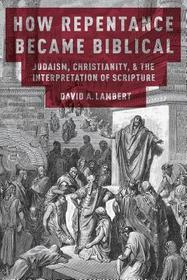
How Repentance Became Biblical
- Publisher's listprice GBP 38.49
-
17 378 Ft (16 550 Ft + 5% VAT)
The price is estimated because at the time of ordering we do not know what conversion rates will apply to HUF / product currency when the book arrives. In case HUF is weaker, the price increases slightly, in case HUF is stronger, the price goes lower slightly.
- Discount 10% (cc. 1 738 Ft off)
- Discounted price 15 640 Ft (14 895 Ft + 5% VAT)
Subcribe now and take benefit of a favourable price.
Subscribe
17 378 Ft

Availability
printed on demand
Why don't you give exact delivery time?
Delivery time is estimated on our previous experiences. We give estimations only, because we order from outside Hungary, and the delivery time mainly depends on how quickly the publisher supplies the book. Faster or slower deliveries both happen, but we do our best to supply as quickly as possible.
Product details:
- Publisher OUP USA
- Date of Publication 28 December 2017
- ISBN 9780190861155
- Binding Paperback
- No. of pages282 pages
- Size 234x155x17 mm
- Weight 440 g
- Language English 0
Categories
Short description:
How Repentance Became Biblical explores the rise of repentance as a concept within early forms of Judaism and Christianity and how it has informed the interpretation of the Hebrew Bible, or Old Testament. It develops alternative accounts for many of the ancient phenomena identified as penitential.
MoreLong description:
Winner of the AAR's 2016 Award for Excellence in the Study of Religion: Textual Studies
How Repentance Became Biblical tells the story of repentance as a concept. Many today, in both secular and religious contexts, assume it to be a natural and inevitable component of our lives. But, where did it originate? How did it become so prominent within Western religious traditions and, by extension, contemporary culture? What purposes does it serve? The book identifies repentance as a product of the Hellenistic period, where it was taken up within emerging forms of Judaism and Christianity as a mode of subjective control. It argues that, along with the rise of repentance, a series of interpretive practices, many of which remain in effect to this day, was put into place whereby repentance is read into the Bible and the Bible, especially the Hebrew Bible, or Old Testament, comes to be seen as repentance's source. Ancient Israelite rituals, such as fasting, prayer, and confession, all of which are incorporated later on within various religious communities as forms of penitential discipline, are understood as external signs of internal remorse. Hebrew terms and phrases, such as the prophetic injunction to "return to YHWH," are read as ancient representations of the concept, repentance. Prophetic literature as a whole is seen as serving a pedagogical purpose, as aiming at the reformation of Israel as a nation. Furthermore, it is assumed that, on the basis of the Bible, sectarians living in the late Second Temple period, from the Dead Sea sect to the early Jesus movement, believed that their redemption depended upon their repentance. In fact, the penitential framework within which the Bible is interpreted tells us the most about our own interpretive tendencies, about how we privilege notions of interiority, autonomy, and virtue. The book develops other frameworks for explaining the biblical phenomena in their ancient contexts, based on alternative views of the body, power, speech, and the divine, and, thereby, offers a new account of repentance's origins.
there can be little doubt that this extremely impressive work will challenge the thinking of scholars of biblical and related literatures for quite some time.
Table of Contents:
Preface
Introduction: The Penitential Lens
Part I - Rites
1. Fasting and the Artistry of Distress
2. The Logic of Appeal
3. Articulating Sin
Part II - Language and Pedagogy
4. A Material (Re)turn to YHWH
5. Power and the Prophetic Utterance
Part III - Religion
6. Agency and Redemption
7. The Genealogy of Repentance
Postscript

