

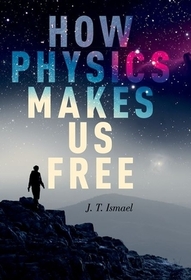
How Physics Makes Us Free
- Publisher's listprice GBP 27.49
-
12 411 Ft (11 820 Ft + 5% VAT)
The price is estimated because at the time of ordering we do not know what conversion rates will apply to HUF / product currency when the book arrives. In case HUF is weaker, the price increases slightly, in case HUF is stronger, the price goes lower slightly.
- Discount 10% (cc. 1 241 Ft off)
- Discounted price 11 170 Ft (10 638 Ft + 5% VAT)
Subcribe now and take benefit of a favourable price.
Subscribe
12 411 Ft

Availability
printed on demand
Why don't you give exact delivery time?
Delivery time is estimated on our previous experiences. We give estimations only, because we order from outside Hungary, and the delivery time mainly depends on how quickly the publisher supplies the book. Faster or slower deliveries both happen, but we do our best to supply as quickly as possible.
Product details:
- Publisher OUP USA
- Date of Publication 15 November 2019
- ISBN 9780190090586
- Binding Paperback
- No. of pages290 pages
- Size 231x155x20 mm
- Weight 431 g
- Language English
- Illustrations 6 illustrations 0
Categories
Short description:
J.T. Ismael's book will be the first to truly examine the question of what physics actually tell us about whether or not we are free to act. Her conclusions are surprising and engaging, and importantly show that physics does actually not say that we are not free.
MoreLong description:
In 1687 Isaac Newton ushered in a new scientific era in which laws of nature could be used to predict the movements of matter with almost perfect precision. Newton's physics also posed a profound challenge to our self-understanding, however, for the very same laws that keep airplanes in the air and rivers flowing downhill tell us that it is in principle possible to predict what each of us will do every second of our entire lives, given the early conditions of the universe.
Can it really be that even while you toss and turn late at night in the throes of an important decision and it seems like the scales of fate hang in the balance, that your decision is a foregone conclusion? Can it really be that everything you have done and everything you ever will do is determined by facts that were in place long before you were born? This problem is one of the staples of philosophical discussion. It is discussed by everyone from freshman in their first philosophy class, to theoretical physicists in bars after conferences. And yet there is no topic that remains more unsettling, and less well understood.
If you want to get behind the façade, past the bare statement of determinism, and really try to understand what physics is telling us in its own terms, read this book. The problem of free will raises all kinds of questions. What does it mean to make a decision, and what does it mean to say that our actions are determined? What are laws of nature? What are causes? What sorts of things are we, when viewed through the lenses of physics, and how do we fit into the natural order? Ismael provides a deeply informed account of what physics tells us about ourselves. The result is a vision that is abstract, alien, illuminating, and-Ismael argues-affirmative of most of what we all believe about our own freedom. Written in a jargon-free style, How Physics Makes Us Free provides an accessible and innovative take on a central question of human
Jenann Ismael's book is a strikingly original monograph that somehow manages to be perfectly relevant and highly engaging to both the intelligent lay reader and the professional philosopher. It shows how well done philosophy of science can be relevant for the public at large, even when treating questions that have, of late, suffered from the ravages of analytic metaphysics. The book may be more widely read inside the academy than outside, but those on the outside who read it in full will surely come away with a better opinion of philosophy than they had at the start. Ismael's prose is beautiful, evocative, and full of helpful metaphors and analogies...It is a book that nobody who cares about how human freedom squares with modern physicalism can afford to ignore.
Table of Contents:
Preface
Part I: Selves in Nature
O A clash of facades
1 What am I?
2 The rise of the Self-governor
3 The Unity of the self
Part II: Human Action and the Natural Order
4 How can I be free if my actions are determined by physical laws? The Consequence
Argument
5 How can I be free if my actions are caused by things outside my control? Causation
6 The Open Future
7 The Paradox of Predictability
8 Self-Constitution; the making of the self
Glossary
Works Cited
Suggestions for Further Reading
Index

