

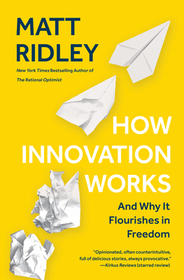
How Innovation Works
And Why It Flourishes in Freedom
- Publisher's listprice USD 29.99
-
9 919 Ft (9 446 Ft + 5% VAT)
The price is estimated because at the time of ordering we do not know what conversion rates will apply to HUF / product currency when the book arrives. In case HUF is weaker, the price increases slightly, in case HUF is stronger, the price goes lower slightly.
- Discount 8% (cc. 794 Ft off)
- Discounted price 9 125 Ft (8 690 Ft + 5% VAT)
Subcribe now and take benefit of a favourable price.
Subscribe
9 919 Ft

Availability
Uncertain availability. Please turn to our customer service.
Why don't you give exact delivery time?
Delivery time is estimated on our previous experiences. We give estimations only, because we order from outside Hungary, and the delivery time mainly depends on how quickly the publisher supplies the book. Faster or slower deliveries both happen, but we do our best to supply as quickly as possible.
Product details:
- Publisher Harper
- Date of Publication 19 May 2020
- ISBN 9780062916594
- Binding Hardback
- No. of pages416 pages
- Size 215x152x38 mm
- Weight 545 g
- Language English 0
Categories
Long description:
Building on his national bestseller The Rational Optimist, Matt Ridley chronicles the history of innovation, and how we need to change our thinking on the subject.
Innovation is the main event of the modern age, the reason we experience both dramatic improvements in our living standards and unsettling changes in our society. Forget short-term symptoms like Donald Trump and Brexit, it is innovation itself that explains them and that will itself shape the 21st century for good and ill. Yet innovation remains a mysterious process, poorly understood by policy makers and businessmen, hard to summon into existence to order, yet inevitable and inexorable when it does happen.
Matt Ridley argues in this book that we need to change the way we think about innovation, to see it as an incremental, bottom-up, fortuitous process that happens to society as a direct result of the human habit of exchange, rather than an orderly, top-down process developing according to a plan. Innovation is crucially different from invention, because it is the turning of inventions into things of practical and affordable use to people. It speeds up in some sectors and slows down in others. It is always a collective, collaborative phenomenon, not a matter of lonely genius. It is gradual, serendipitous, recombinant, inexorable, contagious, experimental and unpredictable. It happens mainly in just a few parts of the world at any one time. It still cannot be modelled properly by economists, but it can easily be discouraged by politicians. Far from there being too much innovation, we may be on the brink of an innovation famine.
Ridley derives these and other lessons, not with abstract argument, but from telling the lively stories of scores of innovations, how they started and why they succeeded or in some cases failed. He goes back millions of years and leaps forward into the near future. Some of the innovation stories he tells are about steam engines, jet engines, search engines, airships, coffee, potatoes, vaping, vaccines, cuisine, antibiotics, mosquito nets, turbines, propellers, fertiliser, zero, computers, dogs, farming, fire, genetic engineering, gene editing, container shipping, railways, cars, safety rules, wheeled suitcases, mobile phones, corrugated iron, powered flight, chlorinated water, toilets, vacuum cleaners, shale gas, the telegraph, radio, social media, block chain, the sharing economy, artificial intelligence, fake bomb detectors, phantom games consoles, fraudulent blood tests, faddish diets, hyperloop tubes, herbicides, copyright and even-a biological innovation-life itself.
"Matt Ridley is one the best non-fiction writers of his generation. He could be described as England's Yuval Harari...His latest book is a pleasure to read: he carries his considerable learning with an engagingly light touch...Great book. Read it. You'll be glad you did." - Forbes Magazine
"Ridley constructs a fascinating theory of innovation, including its prehistoric roots, how it will shape the future and what makes it successful." - Scientific American
"An insightful and charming exploration of questions that range from the truly profound (How does our species capture energy to stave off decay and death?) to the merely fascinating (Why did it take us so long to invent the wheeled suitcase?)." - Steven Pinker
"A fascinating look at how innovations have shaped the modern age and how the process remains integral to the contemporary world...How Innovation Works is a provocative and necessary read for considering future directions for societies and governments." - Shelf Awareness
"In this insightful and delightful book, Matt Ridley explores the wondrous causes of innovation, the force that drives our modern economy. He shows that it's a team sport, but one that features many colorful stars. It's a joy to tag along with him as he mines the history of human advances to discover nuggets of useful lessons."
- Walter Isaacson
"How Innovation Works is an entertaining attempt to explore what innovation is, how it works and why it is resisted... Packed with insightful examples...Engaging." - Financial Times
"Opinionated, often counterintuitive, full of delicious stories, always provocative." - Kirkus Reviews (starred review)
More
