

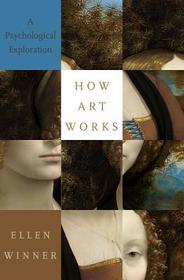
How Art Works
A Psychological Exploration
- Publisher's listprice GBP 30.99
-
13 991 Ft (13 325 Ft + 5% VAT)
The price is estimated because at the time of ordering we do not know what conversion rates will apply to HUF / product currency when the book arrives. In case HUF is weaker, the price increases slightly, in case HUF is stronger, the price goes lower slightly.
- Discount 10% (cc. 1 399 Ft off)
- Discounted price 12 592 Ft (11 993 Ft + 5% VAT)
Subcribe now and take benefit of a favourable price.
Subscribe
13 991 Ft

Availability
printed on demand
Why don't you give exact delivery time?
Delivery time is estimated on our previous experiences. We give estimations only, because we order from outside Hungary, and the delivery time mainly depends on how quickly the publisher supplies the book. Faster or slower deliveries both happen, but we do our best to supply as quickly as possible.
Product details:
- Publisher OUP USA
- Date of Publication 29 November 2018
- ISBN 9780190863357
- Binding Hardback
- No. of pages320 pages
- Size 241x163x25 mm
- Weight 680 g
- Language English 0
Categories
Short description:
This book examines puzzles about the arts wherever their provenance - as long as there is empirical research using the methods of social science (interviews, experimentation, data collection, statistical analysis) that can shed light on these questions. The examined research reveals how ordinary people think about these questions, and why they think the way they do - an inquiry referred to as intuitive aesthetics. The book shows how psychological research on the arts has shed light on and often offered surprising answers to such questions.
MoreLong description:
There is no end of talk and of wondering about 'art' and 'the arts.' This book examines a number of questions about the arts (broadly defined to include all of the arts). Some of these questions come from philosophy. Examples include:
· What makes something art?
· Can anything be art?
· Do we experience "real" emotions from the arts?
· Why do we seek out and even cherish sorrow and fear from art when we go out of our way to avoid these very emotions in real life?
· How do we decide what is good art? Do aesthetic judgments have any objective truth value?
· Why do we devalue fakes even if we -- indeed, even the experts--- can't tell them apart from originals?
· Does fiction enhance our empathy and understanding of others? Is art-making therapeutic?
Others are "common sense" questions that laypersons wonder about. Examples include:
· Does learning to play music raise a child's IQ?
· Is modern art something my kid could do?
· Is talent a matter of nature or nurture?
This book examines puzzles about the arts wherever their provenance - as long as there is empirical research using the methods of social science (interviews, experimentation, data collection, statistical analysis) that can shed light on these questions. The examined research reveals how ordinary people think about these questions, and why they think the way they do - an inquiry referred to as intuitive aesthetics. The book shows how psychological research on the arts has shed light on and often offered surprising answers to such questions.
This shift from philosophical analysis to a robust empirical approach of experiment and observation is the starting point of this book, which is a fascinating account of social scientists' investigations of art through interviews, experiments, data collection, and statistical analysis. Winner touches on a variety of topics ranging from music and emotion, fiction and empathy, the Mozart effect, and perfect fakes and forgeries, to Hockney's theory of optical aids, effort bias, artistic prodigies, deliberate practice and talent, and our curious enjoyment of negative emotions. Recommended for all readers.
Table of Contents:
Table of Contents
Acknowledgments
I. INTRODUCTION
1. Perennial Questions
2. Can This Be Art?
II. ART AND EMOTION
3. Wordless Sounds: Hearing Emotion in Music
4. Feeling Like Crying: Emotions in the Music Listener
5. Color and Form: Emotional Connotations of Visual Art
6. Emotions in the Art Museum: Why Don't We Feel Like Crying?
7. Drawn to Pain: The Paradoxical Enjoyment of Negative Emotion in Art
III. ART AND JUDGMENT
8. Is It Good-Or Just Familiar?
9. Too Easy to Be Good? The Effort Bias
10. Identical! What's Wrong with a Perfect Fake?
11. "But My Kid Could Have Done That!"
IV. WHAT ART DOES - AND DOES NOT - DO FOR US
12. Silver Bullets: Does Art Make Us Smarter?
13. The Lives of Others: Fiction and Empathy
14. Does Making Art Improve Well-Being?
V. MAKING ART
15. Who Makes Art and Why?
VI. CONCLUSION
16. How Art Works
Notes
References
Index

