

- Publisher's listprice GBP 7.99
-
3 607 Ft (3 435 Ft + 5% VAT)
The price is estimated because at the time of ordering we do not know what conversion rates will apply to HUF / product currency when the book arrives. In case HUF is weaker, the price increases slightly, in case HUF is stronger, the price goes lower slightly.
- Discount 10% (cc. 361 Ft off)
- Discounted price 3 246 Ft (3 092 Ft + 5% VAT)
Subcribe now and take benefit of a favourable price.
Subscribe
3 607 Ft

Availability
Uncertain availability. Please turn to our customer service.
Why don't you give exact delivery time?
Delivery time is estimated on our previous experiences. We give estimations only, because we order from outside Hungary, and the delivery time mainly depends on how quickly the publisher supplies the book. Faster or slower deliveries both happen, but we do our best to supply as quickly as possible.
Product details:
- Publisher OUP Oxford
- Date of Publication 24 January 2008
- ISBN 9780192806925
- Binding Paperback
- No. of pages168 pages
- Size 175x110x9 mm
- Weight 142 g
- Language English
- Illustrations 20 black & white illustrations 0
Categories
Short description:
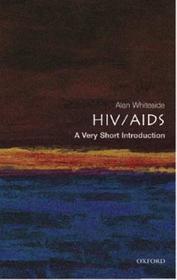
Though first identified in 1981, by 2004 an estimated 40 million people were living with HIV/AIDS and about 20 million had died - numbers which continue to rise as scientists race to find a cure for the worst epidemic to hit humankind since the Black Death.
This book explains the science, the international and local politics, the fascinating demographics, and the devastating consequences of the disease, and explores how we have — and must — respond.
Long description:
HIV/AIDS is without doubt the worst epidemic to hit humankind since the Black Death. The first case was identified in 1981; by 2004 it was estimated that about 40 million people were living with the disease, and about 20 million had died.
Despite rapid scientific advances there is still no cure and the drugs are expensive and toxic. Because of controversies and taboos surrounding safe drug usage and prostitution, the numbers of people infected continues to rise. However, it is in the developing world and especially parts of Africa that the real catastrophe is unfolding. In some of the worst affected countries life expectancy has plummeted to below 35 years, which has led to a serious decline in economic growth, a sharp rise in
orphaning, and the imminent collapse of health care systems.
The news is not all bleak though. There have been unprecedented breakthroughs in understanding diseases and developing drugs. Because the disease is so closely linked to sexual activity and drug use, the need to understand and change behaviour has caused us to reassess what it means to be human and how we should operate in the globalising world. This Very Short Introduction provides an introduction to the disease, tackling the science, the international and local politics, the
fascinating demographics, and the devastating consequences of the disease, and explores how we have — and must — respond.
ABOUT THE SERIES: The Very Short Introductions series from Oxford University Press contains hundreds of titles in almost every subject area. These pocket-sized books are the perfect way to get ahead in a new subject quickly. Our expert authors combine facts, analysis, perspective, new ideas, and enthusiasm to make interesting and challenging topics highly readable.
Packed with statistics and handy explanations of science.
Table of Contents:
The emergence and state of the HIV/AIDS epidemic
How HIV/AIDS works and scientific responses
The factors that shape different epidemics
Illness, deaths, and populations
The impact of AIDS on production and people
AIDS and politics
Responding to HIV/AIDS
The next 25 years

