

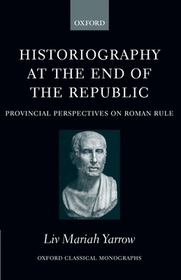
Historiography at the End of the Republic
Provincial Perspectives on Roman Rule
Series: Oxford Classical Monographs;
- Publisher's listprice GBP 222.50
-
100 458 Ft (95 675 Ft + 5% VAT)
The price is estimated because at the time of ordering we do not know what conversion rates will apply to HUF / product currency when the book arrives. In case HUF is weaker, the price increases slightly, in case HUF is stronger, the price goes lower slightly.
- Discount 10% (cc. 10 045 Ft off)
- Discounted price 90 413 Ft (86 108 Ft + 5% VAT)
Subcribe now and take benefit of a favourable price.
Subscribe
100 458 Ft

Availability
printed on demand
Why don't you give exact delivery time?
Delivery time is estimated on our previous experiences. We give estimations only, because we order from outside Hungary, and the delivery time mainly depends on how quickly the publisher supplies the book. Faster or slower deliveries both happen, but we do our best to supply as quickly as possible.
Product details:
- Publisher OUP Oxford
- Date of Publication 6 April 2006
- ISBN 9780199277544
- Binding Hardback
- No. of pages412 pages
- Size 224x145x28 mm
- Weight 629 g
- Language English 0
Categories
Short description:
This is a study of six historians from different corners of the Roman empire at the end of the Republic. All these writers accept the new ruling power, but comment on how that power might best be used. They therefore provide a unique insight into the minds of the conquered peoples and the intellectual culture which allowed them to influence their conquerors.
MoreLong description:
This study of six historians from the edges of the Roman world at the end of the Republic - the author of I Maccabees, Posidonius, Diodorus Siculus, Pompeius Trogus, Nicolaus of Damascus, and Memnon of Heraclea - combines discussion of their biographical details, the intellectual and elite culture in which they composed, and the methodological difficulties of interpreting fragmentary texts, with textual analysis of their representations of Rome. These authors show remarkable unity in their acceptance of Roman hegemony. Nevertheless, their interpretations of Roman rule assume political significance in the light of their intentions in writing and the audiences whom they addressed. They therefore provide a unique insight into the minds of the conquered peoples and the intellectual culture which allowed them to influence their conquerors.
A valuable service has been performed here with an insightful discussion of authors who do not always receive a great deal of critical attention. Care and sobriety characterise Yarrow's scholarship and the result is a book of considerable usefulness.
Table of Contents:
Setting the Scene
The Power of the Intellectual: Leading Thinkers, Thinking Leaders
Theory and Method
Constructing the Narrative: Authorial Objectives and the Use of Rome
From the Outside Looking in: Roman Culture and Domestic Politics
The Romans Abroad: Force, Diplomacy, and the Management of Empire
Enemies of Rome? The Symbolic Alternatives
Conclusion

