

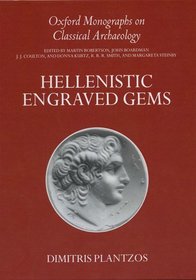
Hellenistic Engraved Gems
Series: Oxford Monographs on Classical Archaeology;
- Publisher's listprice GBP 327.50
-
147 866 Ft (140 825 Ft + 5% VAT)
The price is estimated because at the time of ordering we do not know what conversion rates will apply to HUF / product currency when the book arrives. In case HUF is weaker, the price increases slightly, in case HUF is stronger, the price goes lower slightly.
- Discount 10% (cc. 14 787 Ft off)
- Discounted price 133 080 Ft (126 743 Ft + 5% VAT)
Subcribe now and take benefit of a favourable price.
Subscribe
147 866 Ft

Availability
printed on demand
Why don't you give exact delivery time?
Delivery time is estimated on our previous experiences. We give estimations only, because we order from outside Hungary, and the delivery time mainly depends on how quickly the publisher supplies the book. Faster or slower deliveries both happen, but we do our best to supply as quickly as possible.
Product details:
- Publisher Clarendon Press
- Date of Publication 8 July 1999
- ISBN 9780198150374
- Binding Hardback
- No. of pages260 pages
- Size 285x226x19 mm
- Weight 875 g
- Language English
- Illustrations 96 plates 0
Categories
Short description:
This volume follows the development of Greek gem engraving from Alexander to Augustus. Hellenistic gems are studied in their archaeological context with an assessment of the evidence of their use, significance, and value. The book focuses on subject-matter, technique, and style, as well as problems of chronology and distribution.
MoreLong description:
Engraved gems were used by the Greeks as seals and amulets, but were primarily valued as ornaments. Their iconography was drawn from a wide range of motifs and standard devices current in other art forms. In the Hellenistic period gem cutters remained faithful to the classical tradition, but were able to develop new subjects and styles. Portraits, especially of royalty, became the commonest subject in glyptic after Alexander, a practice that continued through the Roman period and was still popular with patrons and artists of the Renaissance and even later.
This volume follows the development of gem engraving from Alexander's conquest of the East to the Augustan period. Hellenistic gems are studied in their archaeological and historical context: evidence on their use, significance, and value; questions of technique and style; and problems of chronology and distribution. Special sections have been devoted to patronage of gem-engravers and the relationship of gem-cutting with other miniaturist arts and coinage.
provides much of interest both to gem specialists and to those with a more general interest in Hellenistic art and culture.

