

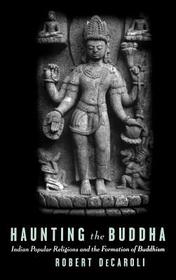
Haunting the Buddha
Indian Popular Religions and the Formation of Buddhism
- Publisher's listprice GBP 76.00
-
34 314 Ft (32 680 Ft + 5% VAT)
The price is estimated because at the time of ordering we do not know what conversion rates will apply to HUF / product currency when the book arrives. In case HUF is weaker, the price increases slightly, in case HUF is stronger, the price goes lower slightly.
- Discount 10% (cc. 3 431 Ft off)
- Discounted price 30 883 Ft (29 412 Ft + 5% VAT)
Subcribe now and take benefit of a favourable price.
Subscribe
34 314 Ft

Availability
printed on demand
Why don't you give exact delivery time?
Delivery time is estimated on our previous experiences. We give estimations only, because we order from outside Hungary, and the delivery time mainly depends on how quickly the publisher supplies the book. Faster or slower deliveries both happen, but we do our best to supply as quickly as possible.
Product details:
- Publisher OUP USA
- Date of Publication 28 October 2004
- ISBN 9780195168389
- Binding Hardback
- No. of pages240 pages
- Size 229x152x17 mm
- Weight 526 g
- Language English
- Illustrations numerous halftones 0
Categories
Short description:
Drawing on fieldwork, textual, and iconographic evidence, DeCaroli offers a comprehensive view of early Indian spirit - religions and their contributions to Buddhism - the first attempt at such a study since Ananda Coomaraswamy's pioneering work was published in 1928. The result is an important contribution to our understanding of early Indian religion and society, and will be of interest to those in the fields of Buddhist studies, Asian history, art history, and anthropology.
MoreLong description:
Early European histories of India frequently reflected colonialist agendas. The idea that Indian society had declined from an earlier Golden Age helped justify the colonial presence. It was said, for example, that modern Buddhism had fallen away from its original identity as a purely rational philosophy that arose in the mythical 5th-century BCE Golden Age unsullied by the religious and cultural practices that surrounded it. In this book Robert DeCaroli seeks to place the formation of Buddhism in its appropriate social and political contexts. It is necessary, he says, to acknowledge that the monks and nuns who embodied early Buddhist ideals shared many beliefs held by the communities in which they were raised. In becoming members of the monastic society these individuals did not abandon their beliefs in the efficacy and the dangers represented by minor deities and spirits of the dead. Their new faith, however, gave them revolutionary new mechanisms with which to engage those supernatural beings. Drawing on fieldwork, textual, and iconographic evidence, DeCaroli offers a comprehensive view of early Indian spirit-religions and their contributions to Buddhism-the first attempt at such a study since Ananda Coomaraswamy's pioneering work was published in 1928. The result is an important contribution to our understanding of early Indian religion and society, and will be of interest to those in the fields of Buddhist studies, Asian history, art history, and anthropology.
This is a bold little book that pushes around some very big problems, and it does what it says it will do: it reopens the question of the relationship between what we call Buddhism and the world of 'spirits' that appears always to have surrounded it.

