

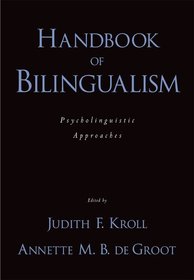
Handbook of Bilingualism
Psycholinguistic approaches
- Publisher's listprice GBP 120.00
-
54 180 Ft (51 600 Ft + 5% VAT)
The price is estimated because at the time of ordering we do not know what conversion rates will apply to HUF / product currency when the book arrives. In case HUF is weaker, the price increases slightly, in case HUF is stronger, the price goes lower slightly.
- Discount 10% (cc. 5 418 Ft off)
- Discounted price 48 762 Ft (46 440 Ft + 5% VAT)
Subcribe now and take benefit of a favourable price.
Subscribe
54 180 Ft

Availability
printed on demand
Why don't you give exact delivery time?
Delivery time is estimated on our previous experiences. We give estimations only, because we order from outside Hungary, and the delivery time mainly depends on how quickly the publisher supplies the book. Faster or slower deliveries both happen, but we do our best to supply as quickly as possible.
Product details:
- Publisher OUP USA
- Date of Publication 23 June 2005
- ISBN 9780195151770
- Binding Hardback
- No. of pages610 pages
- Size 183x254x50 mm
- Weight 1247 g
- Language English
- Illustrations 2pp colour plates, numerous line figures and tables 0
Categories
Short description:
How is language acquired when infants are exposed to multiple language input from birth and when adults are required to learn a second language after early childhood? How do adult bilinguals comprehend and produce words and sentences when their two languages are potentially always active and in competition with one another? What are the neural mechanisms that underlie proficient bilingualism? What are the general consequences of bilingualism for cognition and for language and thought? This handbook will be essential reading for cognitive psychologists, linguists, applied linguists, and educators who wish to better understand the cognitive basis of bilingualism and the logic of experimental and formal approaches to language science.
MoreLong description:
Until recently, cognitive science virtually ignored the fact that most people of the world are bilingual. During the past ten years this situation has changed markedly. There is now an appreciation that learning and using more than one language is the more natural circumstance of cognition. As a result, there is a wealth of new research on second-language learning and bilingualism that provides not only crucial evidence for the universality of cognitive principles, but also an important tool for revealing constraints within the cognitive architecture.
In this volume, Judith Kroll and Annette de Groot have brought together the scientists at the forefront of research on second-language learning and bilingualism to present chapters that, rather than focusing simply on their own research, provide the first comprehensive overviews of this emerging field. Bilingualism provides a lens through which each of the central questions about language and cognition can be viewed. The five sections of this book focus on different facets of those questions: How is language acquired when infants are exposed to multiple-language input from birth, and how is it acquired when adults are required to learn a second language after early childhood? How do adult bilinguals comprehend and produce words and sentences when their two languages are potentially always active and in competition with one another? What are the neural mechanisms that underlie proficient bilingualism? What are the general consequences of bilingualism for cognition and for language and thought? This handbook will be essential reading for cognitive psychologists, linguists, applied linguists, and educators who wish to better understand the cognitive basis of bilingualism and the logic of experimental and formal approaches to language science.
well-done
Table of Contents:
Part 1: Acquisition
The learning of foreign language vocabulary
Syntax
Early bilingual acquisition: Focus on morphosyntax and the separate development hypothesis
A unified model of language development
Phonology and bilingualism
Biological bases
What does the critical period really mean?
Interpreting age effects in second language acquisition
Processing constraints on L1 transfer
Models of monolingual and bilingual language acquisiton
Part 2: Comprehension
Bilingual visual word recognition and lexical access
Computational models of bilingual comprehension
The representation of cognate and noncognate words in bilingual memory: Can cognate status be characterized as a special kind of morphological relation?
Bilingual semantic and conceptual representation
Ambiguities and anomalies: What can eye-movements and event-related potentials reveal about second language sentence processing
Part 3: Production and Control
Selection processes in monolingual and bilingual lexical access
Lexical access in bilingual production
Supporting a differential access hypothesis: Codeswitching and other contact data
Language selection in bilinguals: Mechanisms and processes
Automatically in bilingualism and second language learning
Being and becoming bilingual: Individual differences and consequences for language production
Part 4: Aspects and Implications of Bilingualism
Cognitive consequences
Consequences of bilingualism for cognitive development
Bilingualism and thought
Simultaneous interpreting: A cognitive perspective
Cognitive neuroscience approaches
Clearing the cobwebs from the study of the bilingual brain: Converging evidence from laterality and electrophysiological research
What can functional neuroimaging tell us about the bilingual brain?
The neurocognition of recovery patterns in bilingual aphasics
Models of bilingual representation and processing: Looking back and to the future

