

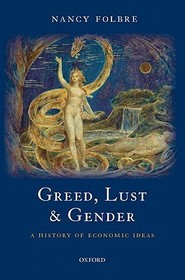
Greed, Lust and Gender
A History of Economic Ideas
- Publisher's listprice GBP 91.00
-
41 086 Ft (39 130 Ft + 5% VAT)
The price is estimated because at the time of ordering we do not know what conversion rates will apply to HUF / product currency when the book arrives. In case HUF is weaker, the price increases slightly, in case HUF is stronger, the price goes lower slightly.
- Discount 10% (cc. 4 109 Ft off)
- Discounted price 36 978 Ft (35 217 Ft + 5% VAT)
Subcribe now and take benefit of a favourable price.
Subscribe
41 086 Ft

Availability
printed on demand
Why don't you give exact delivery time?
Delivery time is estimated on our previous experiences. We give estimations only, because we order from outside Hungary, and the delivery time mainly depends on how quickly the publisher supplies the book. Faster or slower deliveries both happen, but we do our best to supply as quickly as possible.
Product details:
- Publisher OUP Oxford
- Date of Publication 22 October 2009
- ISBN 9780199238422
- Binding Hardback
- No. of pages414 pages
- Size 241x160x26 mm
- Weight 754 g
- Language English 0
Categories
Short description:
This book dramatizes the history of self-interest by describing a centuries-long debate over greed, lust, and appropriate gender roles in terms that ordinary readers will enjoy. Ranging from the 18th century to the present, it offers a deft and engaging critique of economic history and the history of ideas from a feminist perspective.
MoreLong description:
When does the pursuit of self-interest go too far, lapsing into morally unacceptable behaviour? Until the unprecedented events of the recent global financial crisis economists often seemed unconcerned with this question, even suggesting that "greed is good." A closer look, however, suggests that greed and lust are generally considered good only for men, and then only outside the realm of family life. The history of Western economic ideas shows that men have given themselves more cultural permission than women for the pursuit of both economic and sexual self-interest. Feminists have long contested the boundaries of this permission, demanding more than mere freedom to act more like men. Women have gradually gained the power to revise our conceptual and moral maps and to insist on a better-and less gendered-balance between self interest and care for others.
This book brings women's work, their sexuality, and their ideas into the center of the dialectic between economic history and the history of economic ideas. It describes a spiralling process of economic and cultural change in Great Britain, France, and the United States since the 18th century that shaped the evolution of patriarchal capitalism and the larger relationship between production and reproduction. This feminist reinterpretation of our past holds profound implications for today's efforts to develop a more humane and sustainable form of capitalism.
A lively survey of economic thought from the late seventeenth century to the present... A thought-provoking and entertaining read.
Table of Contents:
Introduction
The Eye of the Needle
The Springs of Desire
Defining Virtues
Free Trade but Not Free Love
The Limits of Affection
The Perfectibility of Man
The Greatest Happiness
Self-Love Triumphant
Production and Reproduction
Whose Wealth?
The Social Family
Equal Opportunities
The Subjection of Women
Declaring Independence
The Icy Waters
The Sacred Sphere
The Unproductive Housewife
The Nanny State
Human Capitalism
Beyond Economic Man
Conclusion

