

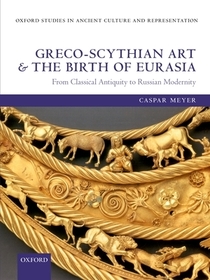
Greco-Scythian Art and the Birth of Eurasia
From Classical Antiquity to Russian Modernity
Series: Oxford Studies in Ancient Culture & Representation;
- Publisher's listprice GBP 180.00
-
81 270 Ft (77 400 Ft + 5% VAT)
The price is estimated because at the time of ordering we do not know what conversion rates will apply to HUF / product currency when the book arrives. In case HUF is weaker, the price increases slightly, in case HUF is stronger, the price goes lower slightly.
- Discount 10% (cc. 8 127 Ft off)
- Discounted price 73 143 Ft (69 660 Ft + 5% VAT)
Subcribe now and take benefit of a favourable price.
Subscribe
81 270 Ft

Availability
printed on demand
Why don't you give exact delivery time?
Delivery time is estimated on our previous experiences. We give estimations only, because we order from outside Hungary, and the delivery time mainly depends on how quickly the publisher supplies the book. Faster or slower deliveries both happen, but we do our best to supply as quickly as possible.
Product details:
- Publisher OUP Oxford
- Date of Publication 28 November 2013
- ISBN 9780199682331
- Binding Hardback
- No. of pages462 pages
- Size 253x195x30 mm
- Weight 1184 g
- Language English
- Illustrations 125 in-text illustrations and 5 maps 0
Categories
Short description:
Drawing on evidence from archaeology, art history, and textual sources to contextualize Greco-Scythian metalwork in ancient society, Meyer offers unique introductions to the archaeology of Scythia and its ties to Asia and classical Greece, modern museum and visual culture studies, and the intellectual history of classics in Russia and the West.
MoreLong description:
Since their discovery in nineteenth-century Russia, Greco-Scythian artefacts have been interpreted as masterpieces by Greek craftsmen working according to the tastes of the Scythian nomads and creating realistic depictions of their barbarian patrons. Drawing on a broad array of evidence from archaeology, art history and epigraphy to contextualize Greco-Scythian metalwork in ancient society, this volume confronts the deep confusion between ancient representation and historical reality in contemporary engagements with classical culture. It argues that the strikingly life-like figure scenes of Greco-Scythian art were integral to the strategies of a cosmopolitan elite who legitimated its economic dominance by asserting an intermediary cultural position between the steppe inland and the urban centres on the shores of the Black Sea. Investigating the reception of this 'Eurasian' self-image in tsarist Russia, Meyer unravels the complex relationship between ancient ideology and modern imperial visions, and its legacy in current conceptions of cultural interaction and identity.
With a synthesis of material evidence never yet attempted, this volume breaks significant new ground in explaining the archaeology of Scythia and its ties to inner Asia and classical Greece, the intersection between modern museum display and visual knowledge, and the intellectual history of classics in Russia and the West.
[a] fascinating and very readable book.
Table of Contents:
Preface and acknowledgements
List of maps
List of figures
List of plates
Abbreviations
Introduction: Discovering Greco-Scythian Art
Classical Art and Russian Identity
Defining the Corpus: Chronology, Technique, Distribution
Political Monuments of the Early Spartocid State
Looking at Greco-Scythian Art
Greco-Scythian Art in Practice
Conclusion
Appendix
Grave inventories of Bosporan elite kurgans of the fifth and sixth centuries BC: a summary guide to excavations conducted 1821-1917
Bibliography
Index

